Friday, March 25, 2011


Thursday, March 24, 2011
Dulce Et Decorum Est
By Wilfred Owen
Bent double, like old beggars under sacks,
Knock-kneed, coughing like hags, we cursed through sludge,
Till on the haunting flares we turned our backs
And towards our distant rest began to trudge.
Men marched asleep. Many had lost their boots
But limped on, blood-shod. All went lame; all blind;
Drunk with fatigue; deaf even to the hoots
Of disappointed shells that dropped behind.
GAS! Gas! Quick, boys!-- An ecstasy of fumbling,
Fitting the clumsy helmets just in time;
But someone still was yelling out and stumbling
And floundering like a man in fire or lime.--
Dim, through the misty panes and thick green light
As under a green sea, I saw him drowning.
In all my dreams, before my helpless sight,
He plunges at me, guttering, choking, drowning.
If in some smothering dreams you too could pace
Behind the wagon that we flung him in,
And watch the white eyes writhing in his face,
His hanging face, like a devil's sick of sin;
If you could hear, at every jolt, the blood
Come gargling from the froth-corrupted lungs,
Obscene as cancer, bitter as the cud
Of vile, incurable sores on innocent tongues,--
My friend, you would not tell with such high zest
To children ardent for some desperate glory,
The old Lie: Dulce et decorum est
Pro patria mori.
Sunday, March 13, 2011
Thursday, March 10, 2011
Media vita in morte sumus - Nicolas Gombert
Media vita in morte sumus,
Quem quaerimus adiutorem nisi te, Domine?
Qui pro peccatis nostris iuste irasceris.
Sancte Deus, sancte fortis, sancte et misericors
Salvator noster amarae morti ne tradas nos.
In the midst of life we are in death;
of whom may we seek help but you, O Lord,
who for our offenses are justly displeased?
Yet, O God most holy, O holy and mighty,
O holy and merciful Savior, give us not over unto bitter death.
Tuesday, March 08, 2011
Prayer for the Dead
God our Father,
Your power brings us to birth,
Your providence guides our lives,
and by Your command we return to dust.
Lord, those who die still live in Your presence,
their lives change but do not end.
I pray in hope for my family,
relatives and friends,
and for all the dead known to You alone.
In company with Christ,
Who died and now lives,
may they rejoice in Your kingdom,
where all our tears are wiped away.
Unite us together again in one family,
to sing Your praise forever and ever.
Amen.
Your power brings us to birth,
Your providence guides our lives,
and by Your command we return to dust.
Lord, those who die still live in Your presence,
their lives change but do not end.
I pray in hope for my family,
relatives and friends,
and for all the dead known to You alone.
In company with Christ,
Who died and now lives,
may they rejoice in Your kingdom,
where all our tears are wiped away.
Unite us together again in one family,
to sing Your praise forever and ever.
Amen.
Requiescat In Pace
David Edward Jr.
March 6, 2011 - March 8, 2011
We knew you so little, and yet we love you so much.
David Edward Jr.
March 6, 2011 - March 8, 2011
We knew you so little, and yet we love you so much.
Monday, March 07, 2011
A Morbid Connection to Heaven:
An Investigation of Relics & The Modern Need for Them
Chapter One: History (Part One)
Chapter One: History (Part One)
Charles Thomas explains that:
The cult of relics, was not just an interesting piece of religious phenomenology. It was a constant, potent, and often spectacular witness to the power of Christianity, countering latent heathenism, bolstering shaky belief, and enhancing the influence of those who taught adherence to the Divine Will, the only possible fount of this miraculous power.
Nor is it exclusive to the Catholic Church. Veneration of the dead was common amongst many, if not all, people. For example, when Buddha died in 483BC his remains were distributed and were housed in buildings called stupus. Even the remains of Confucius began to be venerated in the year 195BC by the Emperor Kao Tsu, and it is continued to this day. The Romans had a similar practice of going and visiting the graves of their relatives. The oddballs in all of this were the Jewish people; they “recognized the veneration of the dead especially of deceased heroes” as stated in the Mosaic Law. But unlike the other cultures of the time, it is not certain if the Jewish people applied a strong religious angle to their burial practices. They feared falling into idolatrous behavior and so suppressed human representation in any form. But in the Old Testament of the Bible the stories of Elisha, in which a dead man was cast unto the bones of Elijah and upon contact came back to life, and Elijah, in which nature reacted to the touch of Elijah's mantle, allow for an early foundation for the cult of relics. There is even less in the New Testament, but the new converts in the time of Saint Paul began dispersing objects that had once belonged to the Apostles. A good example of this comes straight from the Acts of the Apostles, retelling that “God did extraordinary miracles by the hands of Paul, so that handkerchiefs or aprons were carried away from his body to the sick, and diseases left them and the evil spirits came out of them.” This act of trying to get close to Saint Paul led to the practice of distributing brandea, which are cloths that laid “in contact with the remains of the holy apostles”. There has always been a need to be near the holy dead ever since the Early Church as seen with Saint Peter. Evidence shows that many Christians visited Saint Peter's grave and left messages asking him to pray for people. There were also Christian burials, no less then six, near the first Pope's tomb so that they could be near him in death.
The Apostles were not the only ones that the Christians wanted to get a piece of; the new witnesses to the faith were the martyrs giving up their lives for Christ. The Martyrdom of Saint Polycarp recounts the tale of the passion and martyrdom of St Polycarp, who was the bishop of Smyrna, who is worth noting for his aid in resolving the Easter date dispute. There was some difficulty for the Christians of Smyrna retrieving Saint Polycarp's remains, but once they had the remains, they treated them with honor in a religious sense. The Christians did not, as some feared, treat Saint Polycarp as a 'new Christ', but as a member of the mystical body of Christ. Each year after that, the faithful gathered on the anniversary of his martyrdom and celebrated it as a holy feast day. Saint Polycarp was not the only one of the first martyrs to receive such honors. During the persecutions, the supply of martyrs became quite plentiful and the veneration of relics spread as fast as it could across the early Church. Professor Thomas explains that “the Mediterranean owes much, for its physical development, to the evolution of the martyrium or the memoria, the visible … burial-place of a sanctified person.” Christians would gather at these martyria and celebrate the witness of the martyr. Sometimes, these gatherings were accompanied by liturgical celebrations resulting in small shrines begin built over the tombs; the greatest example of this is that of Saint Peter on the Vatican Hill outside of Rome. The catacombs of the early Christians revealed the devotion they had to their dead, stemming from the belief in an afterlife and the resurrection of the body. Since the body was resting temporarily, it only made sense for the Christians to take care of the deceased, since the deceased were going to use it again. In treating the dead to a decent burial nurtured a spiritual connection to fellow Christian brethren in heaven through their corporal remains.
It was not until the Edict of Milan and the Peace of Constantine I that the veneration really began to take off. The small monuments over the graves of martyrs were soon transformed into beautiful sanctuaries and basilicas, with Constantine leading the way with the Basilica over Saint Peter's tomb. When churches were not built over a martyr's resting place, martyrs were brought to rest within the new church, most often directly enshrined in the altar. This link between altar and relics was partially inspired by Revelation 6:9, in which John said he “saw under the altar the souls of those whose had been slain for the word of God and for the witness they had borne,” when the fifth seal was opened.
This, however, came into conflict with the Roman Law of the time; the “Theodosian Code contained severe penalties against the spoliation of graves”. So when a martyr's remains were moved, it was an exceptional event that happened with a very strong reason or even clandestinely. It was not until the eighth century that the penalties were relaxed, thus allowing Popes to authorized a great number of saints' bodies to be moved. It is hard to determine when exactly the practice of venerating fragments of the saint came into being, but it was widespread during the fourth century. The fragments were that of bone or congealed blood, but they were so highly valued that the actual cases that held them were richly decorated and “excessive amounts of money were invested in the shrines that housed them.”
The cases were called reliquaries and they developed alongside the veneration of relics. The earliest reliquaries were essentially boxes, either simply box-shaped or based on an architectural design like a church, such as the reliquary of Saint Colette. With the discovery of the True Cross, relics from the 9th century onwards were housed in magnificent gold and silver cross-shaped reliquaries, decorated with enamels and precious stones. From about the end of the 10th century, reliquaries in the shape of the relics they housed also became popular, for example the skull of Pope Saint Alexander I is housed in a head-shaped reliquary. Similarly, the bones of saints were often housed in reliquaries that recalled the shape of the original body part, such as an arm or a foot, such as the heart of Saint Clare of Montefalco, which resides in a reliquary that is a bust of the saint and the heart can be seen in the chest portion of the bust.
Whenever a saint was moved, it was called a translation; a translation is is the removal of holy objects from one locality, such as a tomb, to another, usually a reliquary or under an altar in a church. Translations can take different forms, including all-night vigils, and the carrying of the precious remains in a reliquary of gold or silver, overshadowed with silken canopies. These acts of translation allowed the holy dead which had “once been exclusively [belonging] to communities scattered throughout the Roman world” to be more accessible to the faithful everywhere. With relics being enshrined in churches everywhere, the faithful no longer had to travel over a dangerous distances. But with such a popular demand for relics, many times these translations were done by stealth. A good example of this can be found in the Translation of Sainte Foy or Saint Faith, in which a monk named Arinisdus is sent to get the relics of Saint Foy from Agen by his superoirs from the monastery Conques “for the salvation of the country and the redemption of many people.” The monk establishes himself within the community of Agen, keeping his real intent secret, and comes to be greatly respected there. After a time, Arinisdus is placed as the guardian of the church, allowing his access to Saint Foy. When the opportunity arises, he breaks into the Saint's tomb and 'reverently' takes the bones. On his journey back to Corques, he, surprisingly, evades his pursuers; even when they are looking right at him, they cannot recognize him. Arinisdus reaches Corques safely, and Saint Foy in entombed in a new reliquary, and Agen is minus one saint.
The writer of the translation wished to do so in a positive sense, casting Arinisdus as a heroic man working for the betterment of souls. For Arinisdus stealing the relics of Saint Foy was a spiritual exercise. If the monastery of Corques was working against the will of God, then Arinisdus would have been caught red-handed; nor did the miracles surrounding Saint Foy's relics cease. If the miracles had stopped, it would have been seen as a sign that saint had been dishonored in some way. Many translations followed a similar pattern as the 'holy' theft of Saint Foy, but not all translations of relics were done by deceit. The approval of bishops was sought to move a saint's remains before anything else would be done. There are several names that are predominate in the realm of relic theft, though they are often called relic merchants to keep their actions honorable ones.
In the ninth century there was Deusdona, a deacon of the Church, who was “no occasional thief but rather the head of a large and highly organized group of relic merchants.” He worked mostly in Italy, his most notable acquisition being the relics of Saints Peter and Marcellinus. Then there was Felix, who was a rather well known merchant and sold relics all over Europe. Later on in the tenth century, King Athelstan of England was known for his passion in collecting relics and his small concern for how his suppliers got the merchandise. One such supplier was Electus, who tried to get the relics of Saint Bertulfus to sell to the King, but was caught before he could even get to the King.
End of Part One.
To Be Continued............
(Copyright: Belongs to the Wanderer)
(If interested in research please contact me.)
To Be Continued............
(Copyright: Belongs to the Wanderer)
(If interested in research please contact me.)
Thursday, March 03, 2011
Do Not Go Gentle Into That Good Night
By Dylan Thomas
Do not go gentle into that good night,
Old age should burn and rage at close of day;
Rage, rage against the dying of the light.
Though wise men at their end know dark is right,
Because their words had forked no lightning they
Do not go gentle into that good night.
Good men, the last wave by, crying how bright
Their frail deeds might have danced in a green bay,
Rage, rage against the dying of the light.
Wild men who caught and sang the sun in flight,
And learn, too late, they grieved it on its way,
Do not go gentle into that good night.
Grave men, near death, who see with blinding sight
Blind eyes could blaze like meteors and be gay,
Rage, rage against the dying of the light.
And you, my father, there on the sad height,
Curse, bless me now with your fierce tears, I pray.
Do not go gentle into that good night.
Rage, rage against the dying of the light.
This has always been a favorite poem of mine. Enjoy!
Monday, February 28, 2011
Revisiting Childhood . . . Or At Least the Cartoons :)
On one of the few days I get off in a week I was mindlessly watching television flipping through channels not really knowing what I wanted to watch. As I channel surfed I realized that many of the shows on were kinda.....let us say dumb for a lack of a better word. For the purpose of this post I am keeping it to the cartoons to avoid an overly long analysis and getting people put off by my comments.
Let's begin with 'Adventure Time'. I really don't know a lot about the show only that it's about a boy (at least, I think it's a boy) and a . . . let's say a dog, going on adventures. I have seen a handful of episodes and each one makes less sense than the last; if there was a plot line in each of the episode I missed them entirely. The thing that really got me was the animation. After watching about ten minutes of the show I wanted to get the eye and brain bleach because it was so painful to watch. Just because it is a show aimed at children does not mean that the animation goes to the wayside. Children enjoy quality as much as adults!!
Let's begin with 'Adventure Time'. I really don't know a lot about the show only that it's about a boy (at least, I think it's a boy) and a . . . let's say a dog, going on adventures. I have seen a handful of episodes and each one makes less sense than the last; if there was a plot line in each of the episode I missed them entirely. The thing that really got me was the animation. After watching about ten minutes of the show I wanted to get the eye and brain bleach because it was so painful to watch. Just because it is a show aimed at children does not mean that the animation goes to the wayside. Children enjoy quality as much as adults!!
Another show with similar animation disaster is 'The Marvelous Misadventures of Flapjack'. As I understand, this show's animation was suppose to be akin to vintage adventure novels. I can see that a little in the design of the background, but the design of the characters and their expression invoked a gag reflex in me. (I'm laughing right now because you think I'm exaggerating -- I'm not) When I was able to watch the show without gagging, the stories were . . . shall we say blah? There was nothing really clever about the adventures the boy, pirate and whale (yes, I said whale) embark upon, just twenty or so minutes of uninspiring cartoon slapstick. The biggest crime of this cartoon is its insult to slapstick -- slapstick done right is unforgettable in the best sense (i.e. Abbot and Costello).
I'm not saying all the cartoons of today are awful. 'Phineas and Ferb' is a crowning achievement of Disney's in recent years where as most of their programing has been lacking. The animation is fun to the point that I am not distracted by the fact that one of the titular character's head is shaped like a triangle. Every child has the same problem Phineas and Ferb have -- to have as much fun as possible during summer vacation before school starts. The slapstick and running gags in this show has an actual point that plays out well in the episode and the series as a whole. Another thing that I found impressive about the show is it has jokes for the parents; it's not the 'if you know what I mean' humour, but the references to things that kids might not necessarily know or watch; two examples come to mind are CSI: Miami and the Shroud of Turin. The jokes for parents are still funny for the kids, and that's a big plus for me!
While I'm still on Disney let's talk about 'Kim Possible'; this is another one that is well done. This show, unlike 'Phineas and Ferb' is aim towards an older audience around 11 to 14ish years old about a teen girl, Kim Possible, saving the world between homework and cheer practice with her clumsy but lovable best friend, Ron Stoppable. It's a fun show with good plot that makes sense and keeps the viewer interested. It set during their high school years and include all the problems that happen during that time. Though the show also dealt with high school problems while saving the world it doesn't bog itself down with the tedious 'I like him - why doesn't he like me! Boohoo!' drama. It's a good mix of action, comedy, and a dash of romance to keep anyone entertained.
I'm not saying all the cartoons of today are awful. 'Phineas and Ferb' is a crowning achievement of Disney's in recent years where as most of their programing has been lacking. The animation is fun to the point that I am not distracted by the fact that one of the titular character's head is shaped like a triangle. Every child has the same problem Phineas and Ferb have -- to have as much fun as possible during summer vacation before school starts. The slapstick and running gags in this show has an actual point that plays out well in the episode and the series as a whole. Another thing that I found impressive about the show is it has jokes for the parents; it's not the 'if you know what I mean' humour, but the references to things that kids might not necessarily know or watch; two examples come to mind are CSI: Miami and the Shroud of Turin. The jokes for parents are still funny for the kids, and that's a big plus for me!
While I'm still on Disney let's talk about 'Kim Possible'; this is another one that is well done. This show, unlike 'Phineas and Ferb' is aim towards an older audience around 11 to 14ish years old about a teen girl, Kim Possible, saving the world between homework and cheer practice with her clumsy but lovable best friend, Ron Stoppable. It's a fun show with good plot that makes sense and keeps the viewer interested. It set during their high school years and include all the problems that happen during that time. Though the show also dealt with high school problems while saving the world it doesn't bog itself down with the tedious 'I like him - why doesn't he like me! Boohoo!' drama. It's a good mix of action, comedy, and a dash of romance to keep anyone entertained.
A show I find perplexing is 'Chowder'; I know there's something about a bakery and the people (or what have you) who run it. Other than that I find it difficult to understand the plot of the episode (if there isn't suppose to be one, please do let me know). The animation, I find, to be one where the animators were trying to be whimsical but ultimately it is a display of disturbing characters. The interaction between characters appears to happen for the sole purpose of slapstick that it becomes unsettling and unwatchable.
I do like weird cartoon, but they have to be done really well. I really enjoyed 'Courage the Cowardly Dog', I really did. Set in the middle of nowhere (literally) about a dog, Courage, who always has to protect his owners from the extremely strange, and unusual things that happen to them. Every episode leave the viewer with a feeling and wondering of 'what just happened?' What I really enjoyed about the show was that no matter what happened to the characters in the show they were always alright by the beginning of the next episode ready for the next weird thing. I wouldn't recommend this show for younger viewers just because the show is so weird and may leave a disturbing feeling with the kiddes. Each episode is self contained which works great for the set up of the show.
I want to leave this post on an up note so I will lastly talk about the DCAU cartoons. DCAU stands for DC Animated Universe which are 'Batman: The Animated Series', 'Superman: The Animated Series', 'Batman Beyond', "Static Shock', 'The Zeta Prodject' and 'Justice League/Unlimited' to name a few. These cartoons had everything from complicated plots that bleed into really engaging story arch to really touching moments between characters, things that gave viewers nightmares to things that gave hope. They were all connected with each other via references; it was possible to watch them separately without needing to watch anything else, but it added to the enjoyment when you did. What really amazes me is how long this continuance lasted; it started in 1992 with 'Batman' (same year as the Tim Burton Batman) and ended in 2006 with 'Justice League Unlimited' -- that's about 14 years. 14 years!!! That's a long time for any show, cartoon or live action, on television. To me that's just a testament of what good story telling can accomplish, and these shows had good story telling overall.
So this is my two cents (or fifty with inflation) on several cartoons.
I do like weird cartoon, but they have to be done really well. I really enjoyed 'Courage the Cowardly Dog', I really did. Set in the middle of nowhere (literally) about a dog, Courage, who always has to protect his owners from the extremely strange, and unusual things that happen to them. Every episode leave the viewer with a feeling and wondering of 'what just happened?' What I really enjoyed about the show was that no matter what happened to the characters in the show they were always alright by the beginning of the next episode ready for the next weird thing. I wouldn't recommend this show for younger viewers just because the show is so weird and may leave a disturbing feeling with the kiddes. Each episode is self contained which works great for the set up of the show.
I want to leave this post on an up note so I will lastly talk about the DCAU cartoons. DCAU stands for DC Animated Universe which are 'Batman: The Animated Series', 'Superman: The Animated Series', 'Batman Beyond', "Static Shock', 'The Zeta Prodject' and 'Justice League/Unlimited' to name a few. These cartoons had everything from complicated plots that bleed into really engaging story arch to really touching moments between characters, things that gave viewers nightmares to things that gave hope. They were all connected with each other via references; it was possible to watch them separately without needing to watch anything else, but it added to the enjoyment when you did. What really amazes me is how long this continuance lasted; it started in 1992 with 'Batman' (same year as the Tim Burton Batman) and ended in 2006 with 'Justice League Unlimited' -- that's about 14 years. 14 years!!! That's a long time for any show, cartoon or live action, on television. To me that's just a testament of what good story telling can accomplish, and these shows had good story telling overall.
So this is my two cents (or fifty with inflation) on several cartoons.
Wednesday, February 23, 2011
Tuesday, February 15, 2011
A Morbid Connection to Heaven:
An Investigation of Relics & The Modern Need for Them
Everyone has a vague understanding of relics; even the most 'un-Churched' person has heard of relics. The question that needs to be asked is a simple one – what are relics? When the modern mind thinks of relics, they think of something old and disgusting, which is partially true, but the thoughts of saints or Heaven do not enter the mind. Relics are something more then just the dead body parts of a holy person. They are a connection to something beyond what we see in the visible world, to the invisible.
People have always wanted to improve their person and wished to be close to those who are better than they. In the early days of the Church, people always scrambled to get close to the Apostles, their successors and other holy people in hopes that a simple touch would improve their fortunes. Even when the holy person has passed on to the the next life, people still wish to touch and be connected. With this mindset, it is not hard to see why the cult of saints and of relics developed. As the Holy Mother Church grew and spread, so did the cult of relics, and the cult was integrated within the liturgy. Soon great devotions brought thousands of pilgrims to the graves of the saints and the churches that held relics. Because of people's faith and their need for graces, miracles began to occur through, not by, the relics of saints. Unfortunately, people turned the desire to be near someone holy for profit and the abuses began, which also brought about great doubt concerning the veneration.
But there will always be doubters about relics and their authenticity, which began strongly with the Protestant Revolt or Reformation. The skeptic will always be able to say, 'This might not have been so-and-so’s,' or 'You might be mistaken,' and there is a possibility that it might be true. There might have been a mistake, or fakes might have been substituted for the real relics. We evaluate relics the same way we evaluate the bona fides of anything else, like visiting where a famous pop star use to live in his youth or something similar. Skeptics have gone to great lengths to disprove some of the more fantastical miracles that occur with relics, such as the liquefaction of Saint Januarius' blood and, especially, the Shroud of Turin. But some relics are beyond doubt, others are so highly probable that it would be rash to doubt. Others are merely probable, and some, yes, are improbable. But since it is not the physical object itself Catholics venerate, it is best not to toss out even most of the skeptical relics, lest you toss out something that really is a relic of the holy dead.
Relics are an aid to the Church Militant in helping Her to remember the goal of Heaven and to have a closer connection to God through His saints. Also, in a round about way, relics can lead to a better understanding and participation in a good wholesome relationship with our fellow man. Relics become a reminder of two things – first that we must die and secondly, and most importantly, that there will be a resurrection of the body.
An Investigation of Relics & The Modern Need for Them
Everyone has a vague understanding of relics; even the most 'un-Churched' person has heard of relics. The question that needs to be asked is a simple one – what are relics? When the modern mind thinks of relics, they think of something old and disgusting, which is partially true, but the thoughts of saints or Heaven do not enter the mind. Relics are something more then just the dead body parts of a holy person. They are a connection to something beyond what we see in the visible world, to the invisible.
People have always wanted to improve their person and wished to be close to those who are better than they. In the early days of the Church, people always scrambled to get close to the Apostles, their successors and other holy people in hopes that a simple touch would improve their fortunes. Even when the holy person has passed on to the the next life, people still wish to touch and be connected. With this mindset, it is not hard to see why the cult of saints and of relics developed. As the Holy Mother Church grew and spread, so did the cult of relics, and the cult was integrated within the liturgy. Soon great devotions brought thousands of pilgrims to the graves of the saints and the churches that held relics. Because of people's faith and their need for graces, miracles began to occur through, not by, the relics of saints. Unfortunately, people turned the desire to be near someone holy for profit and the abuses began, which also brought about great doubt concerning the veneration.
But there will always be doubters about relics and their authenticity, which began strongly with the Protestant Revolt or Reformation. The skeptic will always be able to say, 'This might not have been so-and-so’s,' or 'You might be mistaken,' and there is a possibility that it might be true. There might have been a mistake, or fakes might have been substituted for the real relics. We evaluate relics the same way we evaluate the bona fides of anything else, like visiting where a famous pop star use to live in his youth or something similar. Skeptics have gone to great lengths to disprove some of the more fantastical miracles that occur with relics, such as the liquefaction of Saint Januarius' blood and, especially, the Shroud of Turin. But some relics are beyond doubt, others are so highly probable that it would be rash to doubt. Others are merely probable, and some, yes, are improbable. But since it is not the physical object itself Catholics venerate, it is best not to toss out even most of the skeptical relics, lest you toss out something that really is a relic of the holy dead.
Relics are an aid to the Church Militant in helping Her to remember the goal of Heaven and to have a closer connection to God through His saints. Also, in a round about way, relics can lead to a better understanding and participation in a good wholesome relationship with our fellow man. Relics become a reminder of two things – first that we must die and secondly, and most importantly, that there will be a resurrection of the body.
To Be Continued............
(Copyright: Belongs to the Wanderer)
(If interested in research please contact me.)
(Copyright: Belongs to the Wanderer)
(If interested in research please contact me.)
Thursday, February 03, 2011
The 'Glee' I Heard Made Me Cry
It's been awhile since my last post and my only reason is that I've been extremely busy with ....stuff. A poor excuse indeed, but alas, my only one.
At the persistence of some girls I'm working with in a play, I watched a clip of 'Glee'. I guess it was the end of the episode performance there was no other way for it to fit into the show. The clip was entitled "Singing in the Rain/Umbrella"; it should be noted that I loved the movie 'Singing in the Rain', I grew up watching it, singing the songs and even trying to dance along (the last bit was at the expense of my head and furniture). So I see the title and I think that they are trying to reintroduce old classical showtunes to the modern audience. With that thought I click play . . . two and a half minutes of my life later and I was ready to do two things. The first being to plot the death of the 'Glee' writers and music arragners; second listening to the original 'Singing in the Rain' with Gene Kelly over and over and over again until my mind was purged of the sacrilege I has just heard.
I sent a link of the 'Singing in the Rain/Umberlla' clip to my friend Jackie, who has a much better ear for music than me and can sing fantastically, to get her opinion. Jackie is my go to girl for music, she has been singing Gilbert and Sullivan operas since she was a wee lass and loves theatre as much as myself. I knew I would get a good and through examination of the piece. I wait for her to listen and gather an opinion.
But as I waited for Jackie to get back with me I started listening to other 'Glee' recordings and I noticed something rather interesting about the voices. Let me first say that the singing is decent - no one, from what I've heard, is 'nails on the chalkboard' bad, but that just it . . . they're not bad. There's nothing about the singing that makes me say 'Wow, they're really good!' or 'I want to listen to more of their songs!', it was more along the lines of elevator music -- something to listen to so there no awkward silence between you and the other five strangers going up with you.
I then hear a ping noting Jackie response. Her reaction, I quote, "The cast of Glee should DIE!" I am sure this was a rather mild reaction (it's always so hard to gauge emotions over chat). She makes mention of how the voice sound as though they have been corrected by a computer thus robbing them of any personality in the voice. I agree with her whole heartedly.
The arrangement of the piece also left something lacking. The title suggest that the song 'Singing in the Rain' would be the predominate one of the two merged together, so you could imagine my surprise when I clicked play another song started. It took me a while to remember that 'Umbrella' was a pop song that was over played on the radio a few years back. I was disappointed to find that there was only ONE verse of 'Singing in the Rain' in whole rendition which was over dominated by 'Umbrella'. I was never really a big fan of the song, nor a big opponent -- it was just REALLY over play for me. Out of the two songs I believe that 'Singing in the Rain' deserved more air time, because it is a song that has defined music; its listed as number three on American Film Institute's 100 Years . . . 100 Songs list. Number 3, people!!
On a final note I would like to say that I do not think that the cast of 'Glee' is talentless, I just find them . . . untrained. Give them all good voice instructors and then imagine what they could do. Whatever that would be, it would at least be better then it is now.
Until the next post -- God Bless!
At the persistence of some girls I'm working with in a play, I watched a clip of 'Glee'. I guess it was the end of the episode performance there was no other way for it to fit into the show. The clip was entitled "Singing in the Rain/Umbrella"; it should be noted that I loved the movie 'Singing in the Rain', I grew up watching it, singing the songs and even trying to dance along (the last bit was at the expense of my head and furniture). So I see the title and I think that they are trying to reintroduce old classical showtunes to the modern audience. With that thought I click play . . . two and a half minutes of my life later and I was ready to do two things. The first being to plot the death of the 'Glee' writers and music arragners; second listening to the original 'Singing in the Rain' with Gene Kelly over and over and over again until my mind was purged of the sacrilege I has just heard.
I sent a link of the 'Singing in the Rain/Umberlla' clip to my friend Jackie, who has a much better ear for music than me and can sing fantastically, to get her opinion. Jackie is my go to girl for music, she has been singing Gilbert and Sullivan operas since she was a wee lass and loves theatre as much as myself. I knew I would get a good and through examination of the piece. I wait for her to listen and gather an opinion.
But as I waited for Jackie to get back with me I started listening to other 'Glee' recordings and I noticed something rather interesting about the voices. Let me first say that the singing is decent - no one, from what I've heard, is 'nails on the chalkboard' bad, but that just it . . . they're not bad. There's nothing about the singing that makes me say 'Wow, they're really good!' or 'I want to listen to more of their songs!', it was more along the lines of elevator music -- something to listen to so there no awkward silence between you and the other five strangers going up with you.
I then hear a ping noting Jackie response. Her reaction, I quote, "The cast of Glee should DIE!" I am sure this was a rather mild reaction (it's always so hard to gauge emotions over chat). She makes mention of how the voice sound as though they have been corrected by a computer thus robbing them of any personality in the voice. I agree with her whole heartedly.
The arrangement of the piece also left something lacking. The title suggest that the song 'Singing in the Rain' would be the predominate one of the two merged together, so you could imagine my surprise when I clicked play another song started. It took me a while to remember that 'Umbrella' was a pop song that was over played on the radio a few years back. I was disappointed to find that there was only ONE verse of 'Singing in the Rain' in whole rendition which was over dominated by 'Umbrella'. I was never really a big fan of the song, nor a big opponent -- it was just REALLY over play for me. Out of the two songs I believe that 'Singing in the Rain' deserved more air time, because it is a song that has defined music; its listed as number three on American Film Institute's 100 Years . . . 100 Songs list. Number 3, people!!
On a final note I would like to say that I do not think that the cast of 'Glee' is talentless, I just find them . . . untrained. Give them all good voice instructors and then imagine what they could do. Whatever that would be, it would at least be better then it is now.
Until the next post -- God Bless!
Monday, December 27, 2010
I Survived Christmas And What I Learned
As you may recall from a earlier post secular Christmas is not in my top ten favorites things in the world, but it's not in my top ten hate list. I actually enjoy Christmas Day for the actually reason of the holiday.
As I opened my gifts with my family, I realized that I really need my own place. Do not get me wrong I am grateful for my parents for letting me stay with them, rent-free, after my graduation from college (May 2010). Because of this I am able to spend the money I earn towards my loans which I cannot wait to pay off. But any person who has gone off to college then come home for the holidays knows the plight of readjusting to the rules of their parents. This has been my biggest challenge since graduation. But my current financially situation does not allow me the luxury of moving out.
This realization came to light with the aid of my parents via their gifts. How many people can say they got a microwave for Christmas? Very few I imagine.
On a completely separate note, my New Years resolution: lose weight. I know it's not original, but it's something that I have to do. I'm over weight but not obese (Thank God), but I need to lose about forty pounds to be in my ideal weight for my body type. I have started today; on the recommendations of a dear friend I've invested in those 'Shape-Ups' sneakers, and some hand-weights to hold. The sneakers were a bit weird to wear but when walking I could feel the difference from regular sneakers. We shall see as the year progresses.
I also hope with this oncoming year to pick a little German. My mother's family is ethnically German and I have always been interested in my German roots. I have started listening to Disney songs sung in German to pick up on the pronunciation. When studying French in High School I found that listening to songs (Broadway-esque style not pop) helped a great deal; reason being that in singing to syllables are elongated and over enunciated so you hear the word clearer. But I digress, I've always wanted to pick up some German if any; another reason in the story I'm writing (see earlier post) some of my main characters are German thus I need to know German so the characters can speak in their native tongue.
Until next post, God Bless!
This realization came to light with the aid of my parents via their gifts. How many people can say they got a microwave for Christmas? Very few I imagine.
On a completely separate note, my New Years resolution: lose weight. I know it's not original, but it's something that I have to do. I'm over weight but not obese (Thank God), but I need to lose about forty pounds to be in my ideal weight for my body type. I have started today; on the recommendations of a dear friend I've invested in those 'Shape-Ups' sneakers, and some hand-weights to hold. The sneakers were a bit weird to wear but when walking I could feel the difference from regular sneakers. We shall see as the year progresses.
I also hope with this oncoming year to pick a little German. My mother's family is ethnically German and I have always been interested in my German roots. I have started listening to Disney songs sung in German to pick up on the pronunciation. When studying French in High School I found that listening to songs (Broadway-esque style not pop) helped a great deal; reason being that in singing to syllables are elongated and over enunciated so you hear the word clearer. But I digress, I've always wanted to pick up some German if any; another reason in the story I'm writing (see earlier post) some of my main characters are German thus I need to know German so the characters can speak in their native tongue.
Until next post, God Bless!
A Bit of Fun
Enjoy!
Thursday, December 23, 2010
Wednesday, December 22, 2010
Have you tried writing?

Well I have, and I can tell you it's a lot harder then one thinks.
I have been try to write a modern fantasy series for the past few years. About a year ago the worst possible thing could have happened -- my computer suffered the Blue Screen of Death and was no more.
A moment of silence please.............
Finished? Alright then;
Well, as a result I lost two years worth of work, which included a complete plot-line sketch for the first story, finished character development of all major and minor characters, and so forth. None of which I committed to memory. Ugh! I remember all my main characters and the gist of the plot, but details and minor characters can say bye-bye. So sad... who knows they may return to my subconscious.
This event has lead me to revamp the entire story and write it down on paper. It's harder to organize but it won't get loss from a Blue Screen of Death, it just stays on the book shelf. Despite this set back I find it to be a new opportunity to sort of reinvent the wheel as it were. Most likely because I understand my characters better and how they interact with people and react to event will come across more genuine.
This writing quest of mine started as a way to deal with the Hell my life was going through whilst at college. I, fortunately, survived and so did the story I started, but it grew beyond the therapy. I found myself looking at situations and wondering what my characters would do, what would they think; from that the short story (lost to the Blue Screen of Death) grew into a series of adventures. New characters were slowly added, depth was created, I knew I couldn't keep this all to myself. I told some friends and they added ideas and they even have a fan club for one of the characters.
I highly suggest writing for therapy -- write in a journal, write nonsensical ramblings on a page, write a song, write anything!!! What you write comes from you; after you've written put it away and come back to it later. Think over what is written in front of you and come to your own conclusions. It can be both interesting and fun!
Until next time I leave you with this piece of advice: Adversus solem ne loquitor.
I have been try to write a modern fantasy series for the past few years. About a year ago the worst possible thing could have happened -- my computer suffered the Blue Screen of Death and was no more.
A moment of silence please.............
Finished? Alright then;
Well, as a result I lost two years worth of work, which included a complete plot-line sketch for the first story, finished character development of all major and minor characters, and so forth. None of which I committed to memory. Ugh! I remember all my main characters and the gist of the plot, but details and minor characters can say bye-bye. So sad... who knows they may return to my subconscious.
This event has lead me to revamp the entire story and write it down on paper. It's harder to organize but it won't get loss from a Blue Screen of Death, it just stays on the book shelf. Despite this set back I find it to be a new opportunity to sort of reinvent the wheel as it were. Most likely because I understand my characters better and how they interact with people and react to event will come across more genuine.
This writing quest of mine started as a way to deal with the Hell my life was going through whilst at college. I, fortunately, survived and so did the story I started, but it grew beyond the therapy. I found myself looking at situations and wondering what my characters would do, what would they think; from that the short story (lost to the Blue Screen of Death) grew into a series of adventures. New characters were slowly added, depth was created, I knew I couldn't keep this all to myself. I told some friends and they added ideas and they even have a fan club for one of the characters.
I highly suggest writing for therapy -- write in a journal, write nonsensical ramblings on a page, write a song, write anything!!! What you write comes from you; after you've written put it away and come back to it later. Think over what is written in front of you and come to your own conclusions. It can be both interesting and fun!
Until next time I leave you with this piece of advice: Adversus solem ne loquitor.
Tuesday, December 21, 2010
Christmas: A Time For .......Joy?
Christmas: A Time For .......Joy?
 Christmas to me has been a holy day to celebrate when the Word of God took on flesh. But to many others it's about gift, cookies, Santa, end of the year sales, and decorating. Radio stations begin playing Christmas songs, both secular and religious, before the month of December start has even begun. After living through 20 some odd Christmases I can say without a doubt that I hate Christmas.
 Christmas to me has been a holy day to celebrate when the Word of God took on flesh. But to many others it's about gift, cookies, Santa, end of the year sales, and decorating. Radio stations begin playing Christmas songs, both secular and religious, before the month of December start has even begun. After living through 20 some odd Christmases I can say without a doubt that I hate Christmas.
I hate the decorations that blink on houses as you drive by, the commercialism that bombards me when I turn on the television, everything just fills me with dread. I have, surprisingly a good reason.
I would first like to say that I am far from being a Scrooge. I enjoy giving gifts to people, I do not even need Christmas as an excuse to do so. I value the real meaning of Christmas with all my heart. But when it comes right down to it I'm just burnt out with secular Christmas. Being forced to decorate every year with decoration that are so disgustingly cute made me cringe, it also took out the joy I once had in the holiday. When I went off to college I was forever happy that by the time I got home for Christmas the decorating was overall finished. I dread this time of year because it is at this point where I fight and argue the most with my parents. Both my parents enjoy Christmas, one more then the other; they watch the Christmas themed movies and listen to the music as soon as the radios have switched. I come home to the demands of 'Turn on the Christmas lights,' and 'We have to watch a Christmas movie.' Their love for Christmas has lead me to my Christmas burnout.
I have come to a point in my life in which I must skip Christmas or else I will lose any inkling towards the holiday. I hate Christmas. I wish I didn't, but when a small irritation is blown up and pushed in one's face repeatedly, what can one do?
Sunday, January 25, 2009
A Postscript to Spoon River Anthology
Spoon River Anthology is a collection of free form poems by Edgar Lee Masters about a fictional town called Spoon River. Each poem is an epitaph of each of the citizens delivered by the dead themselves. Here's is one that I wrote. Enjoy!
Change was constant in my Life
I’ve seen different places, different things, different people
Some of which gave me unspeakable joy
Others – a stabbing horror into my heart
Everyday held a task that I had to do
Some I meet with a delightful happiness,
But others put a fear that consumed my very being.
Some of which gave me unspeakable joy
Others – a stabbing horror into my heart
Everyday held a task that I had to do
Some I meet with a delightful happiness,
But others put a fear that consumed my very being.
Failures, achievements came as the day closed into darkness
My closest friends became Tears and Loneliness.
In a crowded room Loneliness was there beside me,
Holding my hand tightly.
As I went to sleep and closed my eyes,
Tears moved his warm hands down my face.
But my greatest friend, I could always find by a lit red candle.
I would often go to my friend by the red candle with Tears and Loneliness
But Tears and Loneliness would stand aback
As my friend by the red candle held me lovingly in His arms.
As His blood dripped from His head to mine
I was reminded of what He did for me.
Though my life these three friends accompanied meMy closest friends became Tears and Loneliness.
In a crowded room Loneliness was there beside me,
Holding my hand tightly.
As I went to sleep and closed my eyes,
Tears moved his warm hands down my face.
But my greatest friend, I could always find by a lit red candle.
I would often go to my friend by the red candle with Tears and Loneliness
But Tears and Loneliness would stand aback
As my friend by the red candle held me lovingly in His arms.
As His blood dripped from His head to mine
I was reminded of what He did for me.
Though the failures and the achievements there they were – always near.
Even at death there they were.
As I lay dying I found myself cold
With Tears’ hands on my face
Loneliness holding my hand tightly
And my friend by the red candle, holding me in His strong loving arms,
With the greatest love in world.
And I believe, with all my heart, that there is no great friend than Him – My friend by the red candle.
 Can any one guess who my friend by the little red candle is? It will be revealed in next post.
Tuesday, July 15, 2008
Update
I lot has been happening to me over the past year.
So much that I haven't been able to post as much as I would like. Please forgive me and I will try to put up something worth reading soon.
God Bless
So much that I haven't been able to post as much as I would like. Please forgive me and I will try to put up something worth reading soon.
God Bless
Saturday, February 10, 2007
Gilbert
I love GK Chesterton!!
And here's a little comic from the Gilbert Magazine that I want to share!!!
And here's a little comic from the Gilbert Magazine that I want to share!!!
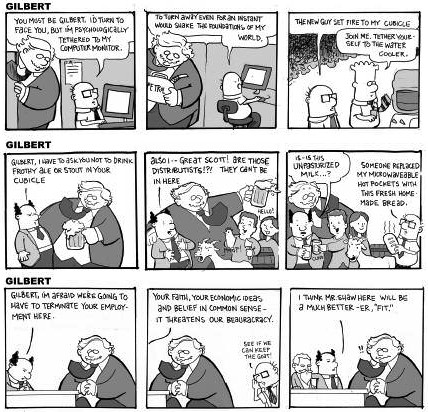
First Strip
1. Wally: You must be Gilbert. I'd turn to face you, but I'm psychologically tethered to my computer monitor.
2. Wally: To turn away even for an instant would shake the foundations of my world.
(Gilbert pulls out a gas canteen)
3. Wally: The new guy set fire to my cubicle.
Dilbert: Join me. Tether yourself to the water cooler.
1. Wally: You must be Gilbert. I'd turn to face you, but I'm psychologically tethered to my computer monitor.
2. Wally: To turn away even for an instant would shake the foundations of my world.
(Gilbert pulls out a gas canteen)
3. Wally: The new guy set fire to my cubicle.
Dilbert: Join me. Tether yourself to the water cooler.
Second Strip
1. Pointy-Haired Boss: Gilbert, I have to ask you not to drink frothy ale or stout in your cubicle.
2. Pointy-Haired Boss: Also, I -- Great Scott!! Are those distributists!?! They can't be in here.
3. Pointy-Haired Boss: Is- Is this un-pasteurized milk?
Wally: Someone replaced my microwaveable hot pockets with this fresh home-made bread.
Third Strip1. Pointy-Haired Boss: Gilbert, I have to ask you not to drink frothy ale or stout in your cubicle.
2. Pointy-Haired Boss: Also, I -- Great Scott!! Are those distributists!?! They can't be in here.
3. Pointy-Haired Boss: Is- Is this un-pasteurized milk?
Wally: Someone replaced my microwaveable hot pockets with this fresh home-made bread.
1. Pointy-Haired Boss: Gilbert, I'm afraid we're going to terminate your employment here.
2. Pointy-Haired Boss: Your faith, your economic ideas, and belief in common sense – It threatens our bureaucracy.
Wally: See if we can keep the goat.
3. Pointy-Haired Boss (with GK's legendary foe G.B. Shaw): I think Mr. Shaw here will be a much better -er, "fit".
Gilbert: !!
Subscribe to:
Posts (Atom)