Showing posts with label history. Show all posts

Wednesday, November 22, 2017

Newspaper Articles for Digital Curation

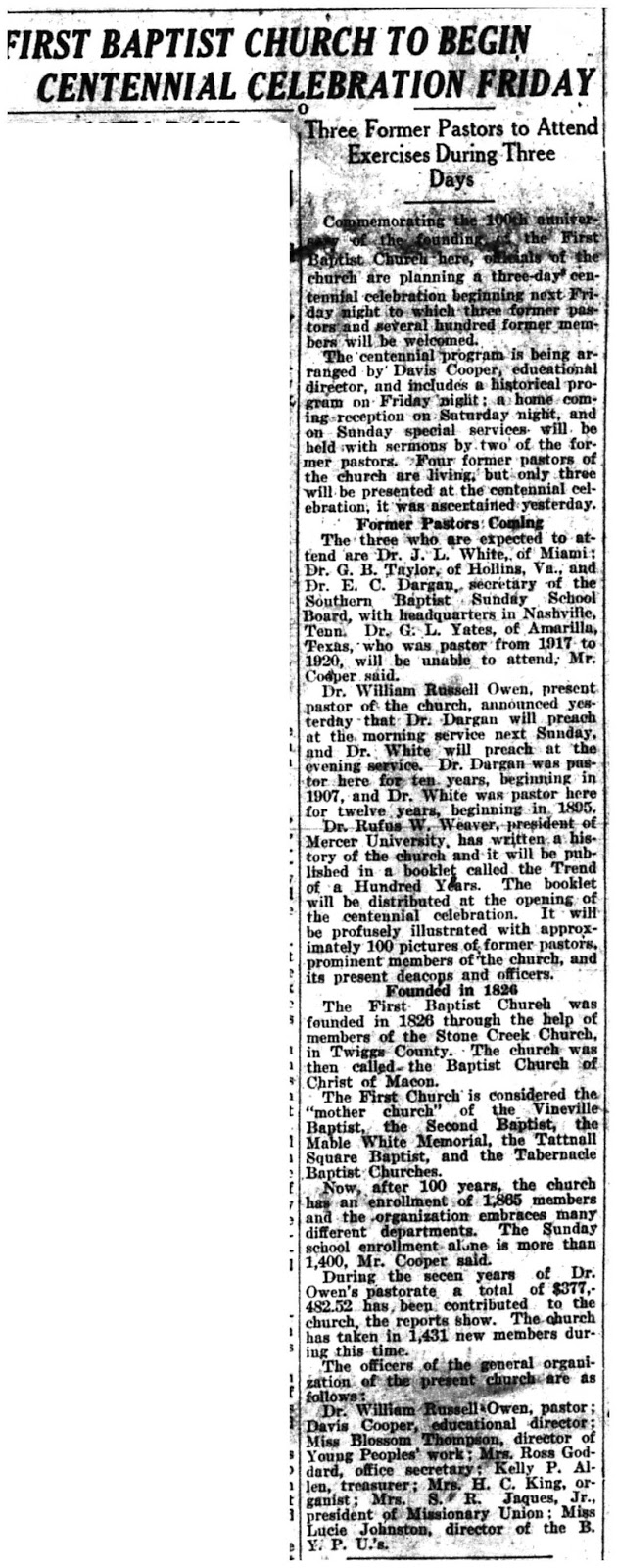
As with the pictures I am posting scans of historic newspapers for my digital collection for class. These scans were procured at the Middle Georgia Archives from their microfilm collection.

These articles are on the two Baptist churches in downtown Macon, GA from the Macon Telegraph. Please do not reuse without citing.


Wednesday, August 31, 2016

The Idea Emerges, a LS 502 post

"Madness does not come by breaking out, but by giving in; by settling down in some dirty, little, self-repeating circle of ideas; by being tamed."
--G.K. Chesterton, Manalive

I have mentioned I'm a little freak out over my Research Methods class? I've done research before for my undergraduate degree, but I can't help but feel that I'm a little out of my depth.

But the Muse has struck!

As I was weeding a collection in the branch library I worked before my transfer, I found a book on Windows 3.1, complete with floppy disks. Now, when I say floppy disks, I mean floppy disks.
For your viewing pleasure:
Note: Advance claim no longer valid.
It struck me that there are people who probably never seen an actual floppy disk in there life. I remember explaining a floppy disk to a friend of mine who is only a few years younger than me and she gave me a confused look. So the thought in my mind is if there are no machines that can read these storage device how can we recover the information that is on there. The door is now locked, never to be open because we have lost the key.

So, with this class I want to look into how do archives make sure that the information, like recordings of oral history, that is saved on computers is not lost because of changes in technology.

I refused to be tamed!!

Friday, August 26, 2016

Useful Articles, a LS 502 Post

I forgot to mention that the journaling for my research class is going to be a bi-weekly posting. Thus another post this week! (Much better than I usually do with this blog.) Just to let you know, these may appear to be random - but, there is a madness to my method.

Over the past few days I have mostly been looking at online articles to get an idea of which direction I want to take my research.

Articles/Posts (that tickled my fancy):
Smithsonian Oral History Collection (What they have in their collection)
Assistive Technology Oral History Project
How Digital Technology Has Changed Oral History
Digital Omnium
List of All Oral Histories (ETHW)
Oral History in the Digital Age


Thursday, February 19, 2015

Top Eleven Random Things You Didn't Know had a Catholic Origin.

(Just my notes for a talk I gave the Middle School Youth Group)
  • 11. Autobiography: We can thank St Augustine of Hippo for the existence of the autobiography.  In his Confessions St Augustine recounts his younger life before his ordination with painful honesty telling the reader his thoughts and reflections of his past actions.
  • 10. Friday the 13th: Friday is the day that Christ died on the cross, something to be cherished and revered, but because it is a day of Christ’s death it has always has a penitential character to it i.e. not eating meat.  As such it developed a reputation of being the unluckiest day of the week.  So beginning any on this day was considered was bad luck (which means I’m in a lot of trouble). 13 was associated with Christ and the 12 apostles, the 13th being Judas the Traitor.
  • 9. Calculator: The first truly operative mechanical calculating device made its appearance in 1642 when Blaise Pascal (French Philosopher, Mathematician, Apologist) wanted to help his father, who was a tax official, with his work.  He called it ‘percaline’, it was 4x20 inches long with 8 dials on its face that was able to add and subtract with great accuracy.  We could also consider the pacaline the first basic computer.
  • 8.A Capella: style of singing without musical instruments. Italian = ‘in the chapel’ written for sacred spaces too small for orchestras or a pipe organ
  • 7. Piñatas: This started out as an Italian sin-bashing during Lent; 
    • there were colorful 7 pignatta ‘fragile pot’ representing the 7 deadly sins that would dance on a rope showing how difficult it is to overcome sin, blindfolded – hard to see as sin.
    • As evil can be defeated by good, we have aids: virture = bat, faith = directions shouted by the crowd, hope = directing his actions heavenwards, charity = when the pignatta is finally busted and sweets shower divine gifts and blessings cascading out
  • 6. Almond Milk: great alternative to cow milk in the Medieval Age, it lasted longer and was often used in Lent when on Fridays one abstained from all animal products.  One couldn’t find a cookbook in a Medieval kitchen that did not have a few recipes that required almond milk.
  • 5. Croissant & Pretzel: I ranked them the same since they are both food items.
    • Croissant: commemorates the Battle of Vienna in 1683, Vienna was an Eastern outpost of Western Christendom against the larger superior army of the Ottoman Empire.  If Vienna had fallen The Turks could have very easily taken over all of Christian Europe, but they were defeated by a spectacular counterattack with a coalition of troops from different Catholic Countries led by the Polish King John Sobieski. 
      • The Legend: Baker heard the Turks trying to tunnel under the city walls and he notified everyone. He was rewarded with a patent to produce a bread to commemorating the victory. The crescent is a symbol of Islam
    • Pretzel: The Lenten treat of Ancient Christianity. In 400s the Great Fast of Lent included total abstinence from all meat and dairy products. Simple bread of flour water and salt in the shape of praying arms (crossed arms across chest in prayer). Were call bracellae Latin for ‘little arms’, from which German brezel or prezel = pretzel
  • 4. Tempura: comes from the observance of Ember Days where there was a mandatory fast and abstain from meat.  The Spanish and Portuguese missionaries of the 16th century settled in Nagasaki, Japan started deep frying shrimp as a tasty alternative for meatless meals.  The idea caught on and the Japanese began to deep fry everything. The name is from Latin  Quatuor Tempora ‘the four seasons’ = the Embertides
  • 3. Groundhog’s Day: Feb 2 Feast of Purification of the BVM – the presentation of Jesus at the Temple 40 days after birth. Simeon’s prophecy of Jesus being a light to the Gentiles (Luke 2:32) led to a folk believe that one could predict the weather on this day. The Germans would use a badger or hedgehog to determine; brought over to Pennsylvania in colonial times and a woodchuck was used. Woodchuck was considered a wise animal by the Indians of the area.
  • 2. Big Bang Theory: not the show! States that at some moment all of space was contained in a single point from which the Universe has been expanding sever since. This theory was first proposed by Fr. Georges Lemaître, Belgian astronomer and professor of Physics at the Catholic University of Leuven. Sounds similar to the creation story, doesn’t it?
  • 1. Solmization: You might know it as the Do-Re-Mi Scale. Hymn in the Divine Office for the Feast of St John the Baptist by Paul the deacon
    • Ut Queant laxis Resonare fibris, Mira gestorum, Famuli tuorum, Solve pollute Labii reatum, Sacte Ioannes.
    • An Italian monk, Gudio of Arezzo noticed that the melody of the hymn ascended precisely one note of the diatonix scale of C at each verse. Took the sybllables for each note of our scale.
Honorable Mentions
  • Cappuccino: said to have been invented by Bl Marco D’Aviano, a Capuchin monk after the Battle of Vienna when a bag of coffee beans left behind by the Turks was found.  He found that it was too bitter for taste thus added milk and honey turning the color brown. Dubbed the drink ‘little Capuchin’ or cappuccino
  • Lobbies: A lobium in medieval Latin was a cloistered walkway where it is believed that many would wait to seek council and help from the monks.
Now enjoy this cappuccino made with almond milk while I calculate the Big Band Theory to the sounds of 'Do a deer' in the background.


Monday, December 22, 2014

Where Did the Advent Wreath Come From and What Does it Mean?

As it is often the case with many traditions that we hold dear to our hearts the Advent wreath has pagan origins and as with many Christmas traditions practiced here in America, this came from Germany.

Evidence shows that the pre-Christian Germanic peoples used wreath with lit candles in the cold dark Winter as a sign of hope for the future warm and extended sun lighted days of Spring.  Similarly, in Scandinavia lighted candles were placed around a wheel and prayers were offered to the god of light to, in a sense, turn the ‘wheel of the earth’ back towards the light of the sun.

As often seen in the Church, especially in the first few centuries, we would take the pagan practices and Christianized it.  This practice of ‘Christionzation’ took what was intrinsically good in the pagan tradition and essentially baptized them into the Church.

By the Medieval period, say about the 16th century or 1500s, the wreath with lighted candles was adapted for Advent as part of a spiritual preparation for Christmas.  Both German Catholics and Lutherans practiced this tradition.  What we would recognize as the Advent wreath took shape in the 19th century or 1800s.  The original wreath started out with a candle for each day of the season, Sundays being big white candles and the rest were smaller red candles.  Over time it simplified to just each Sunday having a candle and sometimes Christmas Day having its own.  This practice was brought over to the United States in the 1930s by German immigrants.

Advent is a time of reflections and preparation and the wreath works as both a reminder and a meditation of what is to come.  It’s easy to perceived the reminder aspect of it, lighting each candle as Christmas gets closer, so let’s focus on the meditative aspect.

It must be understood that the Advent wreath is full of symbols.  This is not a bad thing; symbols are used to help us focus giving us a tangible aspect for the abstract. The act of lighting the candles, with an additional one each week in tandem if the liturgical colors on the candles, represents our expectation and hope of Christ’s first coming, His birth.  That hope and expectation also includes Christ’s second coming at the end of the world.  Remember, everything about Christmas points towards Easter.

This has evergreen, holly leaves, pine cones, and fruit.
To the physical wreath itself:  Traditionally the wreath is made of different types of evergreens wrapped into a circle; the circle has not beginning or end and the evergreen is green throughout the year representing the eternal life of Christ, and his eternal never ending rule.  The wreath can also include holly, pine and yew all of which is symbolic of immortality.  The holly also is symbolic of the crown of thrones worn by Christ at His Passion; there’s also a neat English legend that states the wood of the cross was holly.  Pine cones, seedpods, and nuts can be added for a representation of Christ’s Resurrection. Cedar for strength and healing. Fruits for the nourishing fruitfulness of the Christian Life.  All of this as a whole is Christ, the eternal Word of the Father, who became man was victorious over sin and death by His Passion, Death and Resurrection.

Let us not forget the candles.  As I’ve mentioned before the candles bear the color of the liturgical season; three purple and one rose (not pink).  These are the same colors for the Lent season (again, pointing towards Easter); purple is a reminder of prayer, penance and preparatory sacrifices and good works undertaken during this season (sounds like Lent, doesn't it?). Rose if for Gaudete Sunday, gaudete is Latin for rejoice, this Sunday is the midpoint of Advent and we are close to Christmas.

There’s also some traditions where each candle has a meaning. In one tradition:
Candle #1: Hope, Prophet’s candle representing Jesus’ coming
Candle #2: Faith, Bethlehem candle representing Mary and Joseph’s journey to Bethlehem
Candle #3: Joy, Shepherd’s candle representing the joy at the coming of the birth of Christ
Candle #4: Peace, Angel’s candle representing the message of the Angels ‘Peace on Earth, Good Will towards Men.’

Another tradition:
Candle #1: Patriarchs
Candle #2: Prophets
Candle #3: John the Baptist
Candle#4: Mother Mary

Happy Advent!!

(This is a rough transcript of a lecture I gave to the RCIA class at my church.)

Monday, December 30, 2013

The Development of the Doctrine of the Immaculate Conception

The feast of the Immaculate Conception of Mary was celebrated on the 8th of December.

From the very moment of her conception she was free from the all stain of original sin and in a state of grace. Immaculate means 'without stain'. But she still suffered from the effects of sin – sorrow, illness, death.

How is this possible?
Well, Mary received grace same as us via Christ's death on the cross; His death is an eternal event meaning that the effects of it reach back in time as well as forward. Same as with the Sacrifice of the Mass it cannot be confine to time. God granted her freedom from sin to make her a fitting mother for His Son.

If was officially declared on 8 December 1854 by Pope Pius IX. So does that mean that the Pope just thought of it one day and said to himself 'that's a good idea'?

No it does not.

Let's first start with the Bible (I'm using the Dewey Rheims translation); Genesis 3:15 “I will put enmities between thee and the woman, and thy seed and her seed: she/he shall crush thy head, and thou shalt lie in wait for her heel.”
There is a parallel between Eve and Mary; If there is to be complete enmity between the woman and the serpent, then she never should have been in any way subject to him even briefly. This implies an Immaculate conception.

Luke 1:28 “And the angel being come in, said unto her: Hail, full of grace, the Lord is with thee: blessed art thou among women.”
An angel declared her 'full of grace'; it indicates an unique abundance of grace in her person.
There are a lot angels visiting people in the Bible, but Mary is the only one greeted by 'Full of Grace”

As I've said before the doctrine was not invented in 1854, it was defined or declared. That only happens for two reasons; firstly being that there is a controversy that needs to be cleared up or secondly when the Magisterium believes that the faithful can be helped by a particular emphasis on an already preexisting belief.
The declaration was prompted by the latter of the two. Pius IX had a great devotion to Mary and hoped that the declaration would inspire others in their devotion to Mary.

Let's us now turn to the Fathers of the Church. Now who exactly are these guys? Simple answer: they are men who lived before 750 and are called as such because of their leadership in the early Church, especially in defending, expounding, and developing Catholic doctrines. For the first two centuries, most of these men were bishops, although in later years certain priests and deacons were also recognized as Fathers. They were closes to the sources than we are today.

Many of them make very blatant statements about Mary's immaculate nature.
  • St. Justine Martyr (d.165) the Church’s first major lay apologist, remarks on Mary's obedience to God (her willingness to do His will) in opposite to Eve's disobedience.
  • St. Irenaenus (2nd century) Bishop in Gaul, expands on that saying that Mary's obedience undid what Eve's disobedience brought to man.
  • Origen (184/5-253/4) calls her worthy of God, immaculate of the immaculate.
  • The Syrian Fathers wouldn't shut up (as it were) about her sinlessness.

The Syrians were really the first to have a feast day commemorating this, since about the 5th century. It becomes wide spread by the 7th century in the East and by the 8th it is celebrated in parts of the Western Church.

The feast day became very deeply rooted in Anglo-Saxon monasteries by the 11th century. We even find an old calendar in Winchester dating 1030 with 'Conceptio S'ce S. Mariae'. The monks celebrated it and it was encouraged to the devotion of the individual.

But then, cue ominous music please, the Normans arrived.
For the Normans the feast appeared to be very English, too English; they considered it a product a product of insular simplicity and ignorance (the celebration, not the idea behind it mind you). Thus we can thank the Normans for stopping public devotion, but it lived on in the devotion of the individual. Thank you Normans (sarcasm in abundance here).
It was reestablished, however, by Anselm the Younger, nephew of St. Anselm (Yeah, that's not confusing).

It is after this, going into the 12th century, that we begin to see a confusion over the idea of the Immaculate Conception.
St Bernard of Clairvaux protested what he perceived to be a new way of honoring Mary and reproved the canons (those are people of a religious order who are attached to a particular church) of the Cathedral of Lyons for acting without the authority of Rome when they started celebrating it in 1240. He saw it as a foreign to the traditions of the Church, but here's the kicker – he didn't know that the Church in Greece and Syria had been celebrating the feast with a rich tradition regarding the sinlessness of Mary. (There's no phone system, email, facebook, twitter, or texting)
He was not wrong in wanting a careful inquiry into the reason for observing the feast.

Even St Thomas Aquinas, one of the foremost philosophers and theologians of the Medieval Church, had difficulty grasping the concept. As seen in the Summa Theologica (III.27:2,a2), mostly along the lines of Mary's redemption, how could she be redeemed if she had not sinned.

For some reason, the major philosophers and theologians at the time were stuck on two possibilities:
One, the sanctification of Mary happened before the fusion of the soul into the body; or
Two, the sanctification happened after the union of soul and body.

None of them ever truly considered the moment between – the sanctification of the soul at the moment of conception. The idea of both the sanctification and the fusion of the soul could be simultaneous in time.

This is a good example of how science and faith work together.  When conception was better defined by science it aided in a clearer understanding of the doctrine.

Of course there were some issues, because people always have issues.

St Paul in Romans (5:12) states that all men have sinned via Adam. That would include Mary, right? By this declaration, St. Paul is trying to explain that all men need redemption via Christ. Mary is no exception to this rule as stated before.

Then the silence of the Church Fathers. Well, as we have seen the Church Fathers were not silent, just the ones that most people in the West were reading. There was limited access to those sources and some were lost to them, but not to us today.

It was Blessed John Duns Scotus (d. 1308)(a Franisican) who provided the answer of the simultaneous sanctification and conception. He stated that God had sanctified Mary at the moment of her conception in His foreknowledge that the Blessed Virgin would consent to bear Christ. In other words, she too had been redeemed—her redemption had simply been accomplished at the moment of her conception, rather than (as with all other Christians) in baptism. It was essentially Scotus who laid the foundation of the doctrine that we see to day and Pius IX referenced him when declaring the feast.

After Scotus the doctrine became commonplace at all the major universities and the feast was fast spreading. Most religious orders took up the celebration, except the Dominicans – why? They're sticking with Aquinas.

In 1439 the University of Paris asked the Council of Basle for a dogmatic definition. After 2 years the bishops declared the Immaculate Conception : a doctrine which was pious, constant with Catholic worship, faith, right reason and Holy Scripture and no one could declare contrary to this.

Problem solved, right? 

But wait – this is 1441. The problem? Council of Basle was not an ecumenical council, meaning that anything it declared only effected the area that those bishops lead, not for the Church as a whole. So disputes and discussions continued.

In 1661 P. Alexander VII promulgated in 'Sollicitudo omnium Ecclesiarum' the true sense of the word 'conceptio', and that the immunity of Mary from original sin in the first moment of the creation of her soul and its formation into the body was the subject of the feast. This was when it was finally universally accepted within the Church. So by the time Pius IX promulgated the dogma on 8 December 1854 there was a ring of 'about time'.

In the decades that followed an octave was attached to the feast then became a holy day of obligation, then was allowed a vigil. All of which were in practice in local tradition in many areas.

Our Lady of Immaculate Conception was decreed By the First Council of Baltimore (1846) as the principal Patron of the US.

(This is a rough transcript of a lecture I gave to the RCIA class at my church for the Feast Day.)

Monday, April 22, 2013

Blue and Black: My Reflection on His Holiness Benedict XVI

I have seen the Holy Father Emeritus four times during his reign; as in seen his physical person not just through a television screen.  Each of those moments are very special to me and part of an important event in my life.  Each of those moments, and a few others, I wore blue and black.  I never had the intention to wear that color scheme and now I can't help but associate those colors with him.

I am part of that generation that grew up with Pope Blessed John Paul II, the charismatic pope with a great love for the youth.  To me, and I'm sure many others, he felt like the grandfather we couldn't wait to visit or listen to one of his stories.  I'm not ashamed to say that I cried when he passed away and I know I wasn't the only one who did.  I got up early to watch his funeral and I will admit that I dosed off a few times despite my best efforts (this was before I fell into the common addiction of coffee).  Then I watched with great wonder my first conclave whenever I wasn't in school or at work.

On the day of white smoke and bells was also the day of National Honor Society Inductions.  I was already a member so I got to sit on stage and be dressed in my Sunday best, a blue skirt and a black blouse, which I much preferred to the khaki pants and ill fitted polo of the school uniform.  After some begging, pleading and convincing the teacher of that period turned on the television and I watched as Cardinal Ratzinger, now Benedict XVI, stepped out onto the balcony. A humble worker in God's vineyard.

Later that year (after a year of saving and asking relations to lieu of Christmas gifts to send monies for the trip) I got to go to World Youth Day.  That year it was being hosted in Cologne, Germany which brought an extra meaning to me since I hadn't been to that country since I was born.  I always wanted to go to World Youth Day since I was really young and the fact that it was in Germany was an extra layer of awesome on my epic cake.  This was the first time I saw Benedict XVI without the aid of a TV screen.  I watched the tiny Pontiff in the distance give the final blessing of the last Mass of WYD, I bowed my head and noticed that my black chapel veil was about to slide from my neck.  I wrapped it more securely around my neck and zipped my blue windbreaker closed.

In my college career I transferred once and my first year at my second college was particularly difficult due to miscommunications, misunderstandings, and bias.  During this dark time for me fifty tickets were donated to the school for the Papal Mass that was held at the National Stadium for Benedict XVI's visit to the US.  A drawing was held amongst the students and I put my name in.  On a day filled with tears and hurt, I was told I won one of the fifty tickets.  The smile felt odd after not having one for so long, but it felt good to do it again.

I dressed in the wee hours of the morning the day of the Mass.  Oddly enough, as I looked in the mirror double checking everything, I was wearing the skirt I wore when Habemus Papam was announced; a different blouse but still black.  A bus ride, a trek through the Metro than a shuffle in the crowd I sat in the newly built baseball stadium to have Mass.

One of the better snap shots I got of Pope Benedict XVI.
The same college offered the opportunity to study in Rome for a semester and I took it.   Whilst there my classmates and I were able to attend a Wednesday Audience.  It was outside in St Peter's Square (or circle if you want to get technical about it). I waved enthusiastically as Benedict XVI rode by in the pope-mobile. He knew my school and we got a smile of recognition from  him and almost a two handed waved, but he had to re-grab the bar to keep his balance. My smile grew bigger and my teeth showed.  I sat and listen to talk about St John Leonardi.  He ended his talk with words of encouragement and a blessing.  As he gave his blessing I fiddle with a rosary bracelet around my left wrist.  It had blue and black beads with a medal of the Immaculate Conception.

The owner of the hotel where we were staying was able to get his hands on ticket to the Mass for the Conclusion of the Second Assembly for African of the Synod of Bishops.  Did I want one?  Yes, please!  Not realizing the change in time due to daylights savings, I got up earlier than I had intended.  It was a happy accident as I ended up inside St Peter's Basilica for Mass.  On a side note, the insides are even more awe inspiring when all the lights are on.  I sat at the very end of the row near the front section for the general public resulting in being less than five feet from the Cardinals and the Holy Father himself.  Throughout the Mass two Swiss guards took their posts next to where I sat so I got a good look at the stitching in their colorful uniform.  It was cool that morning and I grabbed a scarf I had purchased in Florence to keep away the chill, which doubled as a chapel veil for me; the scarf was mostly blue and black weaved together to create a design. 

I was just as surprised as anyone when Benedict XVI announced his abdication.  Let me first state that I wish him the best in his new life of prayer and solitude.  On his official last day I had to work, but I was able to schedule my lunch around the time he stepped down so I could pray for him and the next Pope.  I stared at my feet propped up in another chair and then down to what I was wearing; my blue work shirt over a black dress, all cinched with a black belt.  That's when it hit me - blue, black and Benedict XVI.  A strange connection I will admit, some may call it even flimsy, but there it is.

As Pope Blessed John Paul II was the Pope of my youth, Pope Benedict XVI was the Pope of my intellectual development.  In his homily at the closing Mass of his first World Youth Day he said, "In vast areas of the world today there is a strange forgetfulness of God. It seems as if everything would be just the same even without him.  But at the same time there is a feeling of frustration, a sense of dissatisfaction with everyone and everything."  He then encouraged us to "[h]elp people to discover the true star which points out the way to us:  Jesus Christ! Let us seek to know him better and better, so as to be able to guide others to him with conviction."

I saw first hand the forgetfulness that Benedict XVI talked about; with people in my own generation it has resulted from simply not being taught because the two generations ago misunderstood the intention of a Church Council.  In a fit of frustration after a particularly bad religion class I made a deal with God.  If He did not want me to major in Theology in college He would have to lead me in another direction.  From that point to when I declared my major there was nothing that really pushed me away from that degree and thus I now have a BA in Sacred Theology.  Before you ask - I'm not gonna be a priest or preacher!!  You would be amazed how often I'm asked that when people find out my major.

I'm not sure how well I'm leading others to Christ.  I can only hope that I can implant seeds of truth the the minds of those who wish to ignore it because it makes them uncomfortable.  Maybe one day those seeds will bloom into something or at least never leave them.

Today, if one was to take a look at my wardrobe, one would fine a lot of black and blue.  Because of that silly little connection I unknowingly made with those colors and Benedict XVI, I find that I am drawn to them without even thinking about it.  We all find comfort in things; for some it's in a little trinket left to us by someone we love, for others it maybe sharing a pint of ice cream with a friend with one spoon. My comfort is found in the colors blue and black; not in the colors themselves, mind you, but in what they have come to represent to me.

(In case if anyone was wondering, I was wearing brown when Pope Francis was elected.  There's a Franciscan joke in there somewhere, I just can't find it.)

Saturday, February 16, 2013

Best Wishes Holy Father

On April 2005 I was still in high school and on that particular day I was taking part of a program for the National Honor Society.  Because of that particular participation I was required to wear something nice.  I decided on my Sunday best, a blue and white skirt with black line scribbles of flowers and a black blouse with a matching blue collar.  I felt pretty.  The usual khaki pants and school polo had always made me feel frumpy and I was a rather awkward child in high school.  But the only reason I remember all those small little details was that was the day of  'Habemus Papam!'.

It between classes when a classmate of mine apporched me and told me that they was white smoke coming from the Sisten Chapel.

'With the bells?' I asked him.

'Yeah, I think.' He said.

with that I rushed to my next class which, fortunately for me, was a rather pathetic, barely got by on the skin of it's teeth, religion class (I believe it was Comparative Religions) which gave me the perfect excuse to run to my teacher and practically beg to watch the announcement of the next Pope.

I still remember having my eyes glued to the screen while the rest of the classroom couldn't have cared less.

Then the announcement:

Annuntio vobis gaudium magnum:
Habemus Papam!
Eminentissimum ac reverendissimum Dominum,
Dominum Iosephum Sanctæ Romanæ Ecclesiæ Cardinalem Ratzinger,
Qui sibi nomen imposuit Benedictus PP. XVI.

My ear for Latin at the time was underdeveloped so it took me awhile to hear 'Ratzinger'.

I had several thoughts at the time, first was 'When was the last time we had a German pope?'; my second thought when he stepped out on the balcony was 'Wow, he looks a lot like one of my great-uncles, must be the German.'

What truly sadden me that day was the fact that I was so excited for the new Pope and the rest of my school (which supposedly was Catholic) was not.  There was no announcement over the intercom, no moment of silent prayer for the new earthly leader of Holy Mother Church, no one to gleefully jump up and down with me.  It was one of those moments in life where I felt quite alone in a crowded room.

At the time I knew Cardinal Ratzinger through 'The Ratzinger Report' and the fact that he was head of the Office that use to be known as the Inquistion.  But since his election I read as much as I could of all his writings before he was elected and read everything that he published since elected.

Two words: Heavy reading.

Really! I still re-reading everything just to get the general gist of them.

But I have to confess, a big reason I was really excited was that I was going to catch a glimpse of him at the up coming World Youth Day 2005 hosted in Cologne, Germany. A German Pope in Germany for World Youth Day - I had a Catholic geek-out moment there, I'm not ashamed to admit that.

Nearly eight years later His Holiness Benedict XVI, after much prayer and contemplation is abdicating his position.

I cannot tell you how many of my co-workers have asked my opinion of the matter.  So this is just my thoughts on the situation. This.

Thursday, January 31, 2013

Benedictio Cerevisiae

Yes, for those of you who can read Latin, you read that right -- there is a blessing of beer in the Catholic Church found in the old Rituale Romanum, which contains all of the services which may be performed by a priest or deacon which are not contained within either the Missale Romanum or the Breviarium Romanum.  I thought I would share this fun blessing for the joy of all.  I recommend it's use on Oktoberfest or St Patrick's Day. :)

The proper blessing of beers is a proof that we have an awesome religion!

Blessing of Beer

English translation:
V. Our help is in the name of the Lord.
R. Who made heaven and earth.
V. The Lord be with you.
R. And with thy spirit.

Let us pray.
Bless, + O Lord, this creature beer, which thou hast deigned to produce from the fat of grain: that it may be a salutary remedy to the human race, and grant through the invocation of thy holy name; that, whoever shall drink it, may gain health in body and peace in soul. Through Christ our Lord.
R. Amen.

And it is sprinkled with holy water.

Latin Original:
V. Adiutorium nostrum in nomine Domini.
R. Qui fecit caelum et terram.
V. Dominus vobiscum.
R. Et cum spiritu tuo.

Oremus.
Bene+dic, Domine, creaturam istam cerevisiae, quam ex adipe frumenti producere dignatus es: ut sit remedium salutare humano generi, et praesta per invocationem nominis tui sancti; ut, quicumque ex ea biberint, sanitatem corpus et animae tutelam percipiant. Per Christum Dominum nostrum.
R. Amen.

Et aspergatur aqua benedicta.


Yeah, we're just cool like that!
From Catholic Gentleman Blog

Wednesday, July 25, 2012


A Morbid Connection to Heaven:
An Investigation of Relics & The Modern Need for Them
Chapter Two: Relics Today and Their Defense
 
In the movie Singing in the Rain there is a moment near the beginning in which fan-girls start attacking the lead male character and rip his clothing in an attempt to have a piece of him to keep as a memento. It is interesting to note that a culture filled with autograph hounds and with those who become star struck whenever a celebrity comes by can consider the Catholic veneration of relics a joke. A lovely dish is just a lovely dish, but one owned by your grandmother is a special treasure. A pocket-watch gotten at a pawn stop is just a time piece, but one given to you by a grandfather is one you dread losing and would mourn if that were to happen. People are willing to pay a ridiculous amount of money for an article of clothing worn by some famous person, faint at Beatles concerts, and engage in riotous behavior to get their hands on an article of clothing or some other item belonging to a new pop icon; but when a relic of Saint Catherine is mentioned, people snicker.
Especially today, in a world filled with atheists and misinformed Catholics, the snickering gets louder. In the year 2009, some of the relics of Saint Thérèse of Lisieux went on tour around England, even going to a correctional facility, after visiting forty other countries. Many English pilgrims came to see and touch the remains of the French saint. Simon Jenkins, a self proclaimed “Dawkins-ite”, wrote an article concerning the saint's visit to his country. Jenkins finds the whole event rather distasteful, crediting the frenzy that the faithful display towards the relics as “brainwashing of unreason.” But Jenkins decided to be gracious towards the less rational of his fellow man and take up the mantle of courtesy, the same he “would show a Hindu elephant worshiper or a Polynesian medicine man.” Such a mantle is hard to see in the rest of his article, which consists of a rather snarky description of how the relics came across the English channel and what the faithful would do once in reach of the relics. He blatantly states that relics are nothing more then “jujus, [or] religious placebos for the credulous classes” while most rational people “find them ghoulish.”
One of the members of the committee which arranged for Saint Thérèse to visit England, Father Stephen Wang, quickly responded to Jenkin's article. Wang quickly goes into an explanation of why so many come to the relics. People “come to pray; to find inspiration in the life of an extraordinary woman; to deepen their sense of community and belong; to connect with a person they love”; basically people are coming because they are seeking spiritual help. Wang explicitly states that relics are not, as Jenkins says, 'jujus', which are magical charms. A common misconception about relics held by non-Catholics and some Catholics is that relics possess magical powers; there is a supernatural aspect to relics, but there is no 'hocus-pocus' involved with them. The relics are part of the physical aspect of the faith, it is “not just about abstract spiritual truths.” The very act of the Incarnation confirms this – people were able to touch the Word of God and interact with Him. It is of little wonder then that Christianity developed with tangible ways to express the faith; this includes church architecture, polyphonic music and statues alongside of relics.
Today, relics are found in several different states in general. The first is relics lost and forgotten in a museum, where people gawk and wonder why there is a skull in a glided box. Next, the relics become a tourist attraction, like Pope Blessed John XXIII; the Swiss guards usher people along as they take pictures of a partially decomposed man under an altar. The last state, which is probably the most common, is that of relics in some form of a storage room, whether it be in a church or in a museum's back closet; they are hidden away out of sight, and the only way to see them is if one knows somebody with connections to the relics. But above all these states is that in every altar in the churches there has to be a relic, inside according to Cannon Law.
There are three classes of sacred relics depending on the closeness of the object to the saint. The first class are instruments of the Passion of Christ or a part of a saint's body. The relics found in church altars are first class, most likely one of a martyr. Then, the second class relics is a piece of the saint's clothing or something used often by the saint, such as the letters written by Saint Teresa of Ávila. Lastly, third class relics are objects touched to first class relics.
To venerate the relics of the saints is a profession of belief in several doctrines of the Catholic faith. The first of these is the belief in everlasting life for those who have obediently witnessed to Christ and the Holy Gospel whilst on earth. Next is the truth of the resurrection of the body of all persons on the last day, which relates to the doctrine of the splendor of the human body and the respect which all should show toward the bodies of both the living and the deceased. Also, there is the belief in the special intercessory power which the saints enjoy in heaven because of their intimate relationship with God. Last is the truth of our closeness to the saints because of our connection with the communion of saints, since we are all part of the same Church.
To understand how to venerate relics, one must understand the difference between latria, dulia and hyper-dulia. Latria is sacrificial in character, and may be offered only to God. Catholics offer other degrees of reverence to the Blessed Virgin Mary and to the Saints; these non-sacrificial types of reverence are called hyper-dulia and dulia, respectively. Hyper-dulia is essentially a heightened degree of dulia provided only to the Blessed Virgin since she is the revered Mother of God. 

End of Part One.
To Be Continued............
(Copyright: Belongs to the Wanderer)
(If interested in research please contact me.)


Saturday, April 28, 2012

The Problem of Human Shields in Combatant Situations and the Morality of Possible Solutions

Human shields is a term that describes civilians present in or around combat targets to deter an enemy from attacking those targets.  It also describes civilians in a combat situation being forced to walk or march in front of soldiers literately being used as a shield.  Killing civilians always causes problems for whoever shot them, whether it be by accident or on purpose.  An enemy's own people can be used as human shields to deter an enemy.  International humanitarian law forbids using civilians as human shields by placing them next to soldiers, or next to military facilities, with the intention of gaining immunity from attack, or by forcing the civilians to carry out dangerous military assignments.  The very basic concept of the human shields is immoral because it reduces a human being to nothing more than an object to be used.  Human shields also gives the impression that the person is not worth keeping alive, which is true because the person using human shields only cares about his own life.  He does not care who he uses, women, children or the elderly, anybody as long as he escapes.


Captain Daniel P. Schoenekase of the Air Force gives many examples of how human shields have been used in recent military history.  The most recent and most notable violator of international law against the use of human shields has been Iraq in every major conflict they have had since the 1980s.  Cambodia, during the Vietnam War, used ethnic Vietnamese civilians as human shields against their own government.  During the civil war of Sierra Leone in the 1990s people of the Revolutionary United Front would regularly kidnap children and used them as human shields against the government forces.  In these few examples one can see the moral repulsiveness of forcibly using civilians as shields against attack of any form.

There are several types of human shields -- proximity, involuntary or hostages, and and finally willing human shields.  The first kind, the proximity shields, are near military target, and the presence of these people present a great likeliness of high civilian causalities.  The civilians causalities could then be used by the opposing force in propaganda to put their enemy in a more bitter opinion of their people, thus preventing the enemy from gaining allies within their borders.  Most of the time the proximity human shields do not even know that they are being used as shields.  Usually they are people who are in a neighborhood or even hopitals.  For example, during the Gulf War Saddam Hussein would station his weapons near hospitals, knowing that the American forces would not fire so close to civilians, especially the sick and injured.  At the time nothing could be done effectively to get at the weapons.  Aiming with the missiles at the time was pointing in the general direction and hope that it would hit close enough to the target to cause some damage.  Today targeting systems are much better, so the military can fire a drone guided missile and direct the missile to hit the target, and the surrounding areas take minimal damage.

The next type of human shield are the involuntary, also known as hostages.  a hostage is defined as "a person given as a pledge or taken prisoner as by an enemy or terrorist, until certain conditions are met."  Any civilian in a combat situation are at risk of being taken and used b soldiers of either side.  However, the taking and using of hostages is strictly forbidden by the fourth Geneva Convention.

Finally there are the voluntary shields, who are a recent development in the war with Iraq.  A voluntary human shield is someone who is usually a foreign peace activist who comes and stand in the way of military in peaceful protest of the war.  Captain Schoenekase explains in his article  that in recent years debates have arisen on "whether voluntary human shields have become a form of quasi-combatant by their active participation."  The Human Rights Watch says that since that these voluntary shields are not actively engaged in hostile behavior towards either sides, they should be treated as non-combatants and retain civilian status. Some scholars say that voluntary human shields have forfeited their immunity of being civilians.  This argument states that anyone who has willing taken positions at the location of a military target has acted knowing the risk they were taking and they have little right to be considered as a non-combatant

When dealing with a situation involving human shields, there are several options that are available.  The easiest option is to kick down the door and go in guns blazing and shoot everyone in sight.  Both shields, willing or not, and the bad guys are dead, but the problem is solved.  It is similar to surgery when the doctor has to remove a tumor.  The healthy cells are removed for the greater good of the whole.  But one cell and a complete human being has a great deal of difference in importance.  The option of guns blazing is mostly condemned by international law and by most people in the world.  it is immoral because it violates the persons' dignity; no care is given to the non-combatants who most likely did not want to be in a fighting situation.  Killing everyone in sight also is a failure of a soldier to fulfill his purpose which would be fighting for the good of the citizens of that country.

Then there is the option of negotiation, which is used in situations with hostages, especially when the situation is not a full-out combat.  This option's morality can go either way.  There is a risk of the enemy getting away in the process of negotiation, and they might kill the hostages even if they get all they demanded.  But one must also consider what to do if the enemy demands and entirety of several large banks for the lives of a few hostages.  It is a hard choice between bankrupting the city, affecting thousands of people's lives, or saving the life of a handful of people.

Another option is the use of mob control weapons that police have used in the United States.  The police use things like rubber bullets and tear gas to subdue and disperse a crowd without needing to pull out a gun that uses bullets to kill.  The most damage that rubber bullets do is give anyone that it strikes a big and painful bruise, but they are alive, and tear gas mostly likely leaves stinging eyes and a bad tastes in one's mouth,  Also, in the confusion of the tear gas, a soldier can get closer to the enemy to get a clearer hit.  Captain Schoenekase also explains that "soldiers can be trained to deal with human-shields tactics through advance marksmanship training that emphasizes target detection, acquisition, discrimination, and engagement."  The morality in these options is actually positive, the dignity and lives of the people used as human shields is preserved.

Human shields are an ugly thing that has arise because of war.  Innocent women, children, and elderly are forced into combat situations in which they do not know if they are going to live or die.  The immorality of human shields is unquestionable with the way human shields are treated.  The dignity of the lives of the non-combatants becomes worthless when used as a shield -- they become nothing more than a tool.  Soldiers, when they fight, try to minimize the amount of collateral damage to protect civilians as much as they can and is a requirement set before they by their commanding officers.  The solutions presented above each have something to offer when dealing with human shields and each have a different degree of morality.

Friday, December 16, 2011

Is That What You Think?

Even after living in the Bible Belt for over a decade I am always surprised about the misconceptions of non-Catholics of Catholic beliefs.  Granted there is about 500 years of rumors developing and confusion becomes a blaze that spreads quickly on dry grass.

Growing up I always knew that I would go to college and major in Theology, even though I never really knew what I would do with that degree.  I wanted to know everything about my faith and was tired of my religion class teachers giving me wishy-washy answers that did not clarify anything.  I grew up with a strong example of the faith from my parents, who made sure we learned our Hail Marys and Our Fathers like all good Catholic boys and girls.  At some point I became interested in the meaning behind the traditions and rituals that had developed in the Church and from that, my fascination with relics.  All the tradition we have in the Church there is a meaning behind it, ranging from the types of vestments the priest wears during the Mass (and outside the Mass as well) to the simple act of crossing ourselves before prayer.  As I entered my young adult life I had studied beyond what was required for class to feed the hunger I had to know more about my faith.  My parents even started asking me questions of something or other concerning the faith (even a few upperclassmen too).


I could not see myself studying anything else.  But now I have a degree in Theology - what to do?  Why, teach it of course!  The RCIA (Rite of Christian Initiation for Adults) program at my church was a good way to get my feelers out to see if I would make a half-way decent teacher.  And thus a journey of discovery began.

Remember I'm in the Bible Belt, so a lot of out inquirers are from very Protestant backgrounds, many of which still hold the Catholic Church in contempt.  There are things that I always thought simple and basic to understand that many of the Inquirers have a hard time wrapping their heads around it.  Many of them do not understand at first that being Catholic is a lifestyle and joining the Catholic Church is not like moving to a new house up the street.  Oh no, it's more along the lines of becoming a citizen of a different country whose culture is similar but different in so many ways.  It's out of the comfort zone of many people and it scares them, sometimes it can be too much.

For those who the change is too much for, they sometimes lash out at us who teach them.  This reaction, however, is not limited to people in the RCIA program. I am in no means saying that this is a one way street.  Catholics also have some misconjectures when is comes to their Protestant brethren. 

The goal in life is to find the truth, no matter what our situation in life is we have to find it.  For as they say Christ is the Way, the Life and the Truth.

Monday, December 05, 2011


A Morbid Connection to Heaven:
An Investigation of Relics & The Modern Need for Them
Chapter One: History (Part Two)
  There were several reasons used to justify the stealing of relics. First was the basic need of relics for new churches and religious organizations that were being established; the churches had to possess a relic before they could be properly consecrated. When there was a strong devotion to a particular saint, the physical remains of that saint tended to appear to act as a focal point for the devotion. Relics were also used as a form of spiritual protection against the injustice of secular authority. This, in turn, lead to competition amongst the religious communities of whom had who of the holy dead, spurring translations. Relics were also a source of income for monasteries from the donations that pilgrims would give in hope of intercessions from the saint. So in a sense relics of a saint became a form of a fund raiser for a community and even collectible items, and owning them became a symbol of prestige for cities, kingdoms, and monarchs.
It is hard to overstate the importance of the cult of the relics during the Middle Ages. They were used in the dedication of churches where they were integrated into the altar; they were used in law courts for swearing oaths; relics were found on the battlefield as suggested by the description of Roland's sword in the Song of Roland. In short, relics were an integral part of daily life and were accepted unquestioningly. The cult of the relics played a critical role in the missionary activities. The missionaries who converted northern Europe were dealing with people whose religion was fundamentally animistic. To them, it seemed that the entire world was inhabited and controlled by unseen powers; every tree had its own spirit, every pool its devil, every mountain its god. There was no distinction between the laws of nature and the laws of God. In accepting Christianity, pagans believed Christ's powers to be more potent than those of their former gods. The converts expected the new God to intervene as often and as powerfully in nature as the old, and if He failed to do so, they would frequently revert to their old beliefs. Gregory the Great recommended to Augustine of Canterbury that the cult of the saints and martyrs be presented to the English as the rival to pagan animism.
As the Medieval Age wore on, “relics came to be displayed more prominently in the churches” more so than before; even the reliquaries and altar tombs became more ornate to draw attention to the strange treasure. This brought a greater demand unto the relic market; so when the Crusades allowed access to the Holy Land for Western Europe and the saints that rested there, it was a welcome conflict. When Constantinople was sacked in 1204, a great number of relics were found and sent back, including those of Saint Catherine of Alexandria. But for some reason, when the relics were sent back, they were not sent in their original reliquaries. Since the relics were not in their reliquaries, there was only the word of the relic-monger that the bones were those of a saint. With the lack of identification, the relic market was flooded by false relics, and it became hard to distinguish between the true saint relic and bones of an animal. The Council of Lyon forbade anyone to venerate any relic new on the scene without proper approbation by the Pope.  But once the relic was discovered, authenticated and enshrined in a church, pilgrims came flocking. Setting out on a pilgrimage to visit shrines that housed a relic became a way to be blessed and forgiven of sins. Often pilgrimages were prescribed by confessors as a form of penance.
The veneration of relics had a strong following until the sixteenth century, when the Protestant Reformation occurred. The Protestants had a rather violent reaction against the cult of relics and the saints to whom they belong, particularly the idea of saintly intercession. Martin Luther opposed the use of relics since many had no apparent proof of historic authenticity or any biblical support; it also “constitute[d] a reliance on works rather than on faith.”  Luther saw the cult of relics as an invention of the Roman Church. John Calvin rejected relics based on theology; and his followers, particularly in Northern Europe, destroyed many reliquaries, melting them and taking the precious gems that adorned them.  Calvin himself, though, confined his attacks to relics that appeared to be improbable, such as the multiple heads of Saint John the Baptist and even claimed that if one took all the pieces of the True Cross and put them together it would make a large ship. The Huguenots in France were probably the most violent when destroying reliquaries.  Some of the French churches still bear the marks of their attacks.  In England, many relics were destroyed, especially the relics of Saint Thomas à Becket, which were taken from their reliquary, burned, and the ashes spread to the winds, though some say that Becket's bones were hidden elsewhere in the Cathedral.
The Council of Trent convened in 1545 in response to the criticisms of the Protestants. The Council, in its twenty-fifth session, stressed that, despite the lack of Biblical support, the veneration of relics was a legitimate devotion basing on the Apostolic tradition and the constant practices of the Church. There was also an affirmation of what earlier councils (such as Council of Lyon) and synods had said, especially the condemnation of anyone who denied the cult of relics as false or unholy. It also stressed the need for the cult of relics to be under the direct supervision of the Holy See and not the local bishops. Much of what Trent did to reorganize the veneration of relics still holds true today.
After Trent, however, the devotion to relics never returned to the level of fervor it had before the Protestant Reformation. Not much attention was given to them until the theologian F. Suarez collected the teachings concerning relics and commented upon them. He built his argument on top of Saint Augustine's saying that “the relation between the saint and his relics is not to be sought in physical continuity … but in the reason on which the moral dignity of the relics is based.”  Around the age of so-called Enlightenment, theologians had differing views of the cult of relics. Some viewed the cult of relics on a different, even a lower, level then that of the cult of saints, but others viewed the cult on the same level. Saint Robert Bellarmine, in his De Ecclesia trimphanti distinguished the respect and honor given to relics here on Earth and the honor given to the saints in Heaven. Cardinal Billuart explains that relics as materiel objects have absolutely no right to be venerated, and that this right comes in the formal aspect in which they are worthy of the same veneration as the saint.
The cult of relics has never been a foreign idea in the Catholic Church; it has been there since the beginning and is by no means an invention of the Medieval Church. It has been an integral part the the Church's development and has aided in the strengthening of the resolve of the faithful. This veneration of the holy dead still plays a role today in the Church and should not be discontinued.

End of Part Two.
End of Chapter One.
To Be Continued............
(Copyright: Belongs to the Wanderer)
(If interested in research please contact me.)

Monday, March 07, 2011

A Morbid Connection to Heaven:
An Investigation of Relics & The Modern Need for Them
Chapter One: History (Part One)
Charles Thomas explains that:

The cult of relics, was not just an interesting piece of religious phenomenology. It was a constant, potent, and often spectacular witness to the power of Christianity, countering latent heathenism, bolstering shaky belief, and enhancing the influence of those who taught adherence to the Divine Will, the only possible fount of this miraculous power.

Nor is it exclusive to the Catholic Church. Veneration of the dead was common amongst many, if not all, people. For example, when Buddha died in 483BC his remains were distributed and were housed in buildings called stupus. Even the remains of Confucius began to be venerated in the year 195BC by the Emperor Kao Tsu, and it is continued to this day. The Romans had a similar practice of going and visiting the graves of their relatives. The oddballs in all of this were the Jewish people; they “recognized the veneration of the dead especially of deceased heroes” as stated in the Mosaic Law. But unlike the other cultures of the time, it is not certain if the Jewish people applied a strong religious angle to their burial practices. They feared falling into idolatrous behavior and so suppressed human representation in any form. But in the Old Testament of the Bible the stories of Elisha, in which a dead man was cast unto the bones of Elijah and upon contact came back to life, and Elijah, in which nature reacted to the touch of Elijah's mantle, allow for an early foundation for the cult of relics. There is even less in the New Testament, but the new converts in the time of Saint Paul began dispersing objects that had once belonged to the Apostles. A good example of this comes straight from the Acts of the Apostles, retelling that “God did extraordinary miracles by the hands of Paul, so that handkerchiefs or aprons were carried away from his body to the sick, and diseases left them and the evil spirits came out of them.” This act of trying to get close to Saint Paul led to the practice of distributing brandea, which are cloths that laid “in contact with the remains of the holy apostles”. There has always been a need to be near the holy dead ever since the Early Church as seen with Saint Peter. Evidence shows that many Christians visited Saint Peter's grave and left messages asking him to pray for people. There were also Christian burials, no less then six, near the first Pope's tomb so that they could be near him in death.

The Apostles were not the only ones that the Christians wanted to get a piece of; the new witnesses to the faith were the martyrs giving up their lives for Christ. The Martyrdom of Saint Polycarp recounts the tale of the passion and martyrdom of St Polycarp, who was the bishop of Smyrna, who is worth noting for his aid in resolving the Easter date dispute. There was some difficulty for the Christians of Smyrna retrieving Saint Polycarp's remains, but once they had the remains, they treated them with honor in a religious sense. The Christians did not, as some feared, treat Saint Polycarp as a 'new Christ', but as a member of the mystical body of Christ. Each year after that, the faithful gathered on the anniversary of his martyrdom and celebrated it as a holy feast day. Saint Polycarp was not the only one of the first martyrs to receive such honors. During the persecutions, the supply of martyrs became quite plentiful and the veneration of relics spread as fast as it could across the early Church. Professor Thomas explains that “the Mediterranean owes much, for its physical development, to the evolution of the martyrium or the memoria, the visible … burial-place of a sanctified person.” Christians would gather at these martyria and celebrate the witness of the martyr. Sometimes, these gatherings were accompanied by liturgical celebrations resulting in small shrines begin built over the tombs; the greatest example of this is that of Saint Peter on the Vatican Hill outside of Rome. The catacombs of the early Christians revealed the devotion they had to their dead, stemming from the belief in an afterlife and the resurrection of the body. Since the body was resting temporarily, it only made sense for the Christians to take care of the deceased, since the deceased were going to use it again. In treating the dead to a decent burial nurtured a spiritual connection to fellow Christian brethren in heaven through their corporal remains.

It was not until the Edict of Milan and the Peace of Constantine I that the veneration really began to take off. The small monuments over the graves of martyrs were soon transformed into beautiful sanctuaries and basilicas, with Constantine leading the way with the Basilica over Saint Peter's tomb. When churches were not built over a martyr's resting place, martyrs were brought to rest within the new church, most often directly enshrined in the altar. This link between altar and relics was partially inspired by Revelation 6:9, in which John said he “saw under the altar the souls of those whose had been slain for the word of God and for the witness they had borne,” when the fifth seal was opened.

This, however, came into conflict with the Roman Law of the time; the “Theodosian Code contained severe penalties against the spoliation of graves”. So when a martyr's remains were moved, it was an exceptional event that happened with a very strong reason or even clandestinely. It was not until the eighth century that the penalties were relaxed, thus allowing Popes to authorized a great number of saints' bodies to be moved. It is hard to determine when exactly the practice of venerating fragments of the saint came into being, but it was widespread during the fourth century. The fragments were that of bone or congealed blood, but they were so highly valued that the actual cases that held them were richly decorated and “excessive amounts of money were invested in the shrines that housed them.”

The cases were called reliquaries and they developed alongside the veneration of relics. The earliest reliquaries were essentially boxes, either simply box-shaped or based on an architectural design like a church, such as the reliquary of Saint Colette. With the discovery of the True Cross, relics from the 9th century onwards were housed in magnificent gold and silver cross-shaped reliquaries, decorated with enamels and precious stones. From about the end of the 10th century, reliquaries in the shape of the relics they housed also became popular, for example the skull of Pope Saint Alexander I is housed in a head-shaped reliquary. Similarly, the bones of saints were often housed in reliquaries that recalled the shape of the original body part, such as an arm or a foot, such as the heart of Saint Clare of Montefalco, which resides in a reliquary that is a bust of the saint and the heart can be seen in the chest portion of the bust.

Whenever a saint was moved, it was called a translation; a translation is is the removal of holy objects from one locality, such as a tomb, to another, usually a reliquary or under an altar in a church. Translations can take different forms, including all-night vigils, and the carrying of the precious remains in a reliquary of gold or silver, overshadowed with silken canopies. These acts of translation allowed the holy dead which had “once been exclusively [belonging] to communities scattered throughout the Roman world” to be more accessible to the faithful everywhere. With relics being enshrined in churches everywhere, the faithful no longer had to travel over a dangerous distances. But with such a popular demand for relics, many times these translations were done by stealth. A good example of this can be found in the Translation of Sainte Foy or Saint Faith, in which a monk named Arinisdus is sent to get the relics of Saint Foy from Agen by his superoirs from the monastery Conques “for the salvation of the country and the redemption of many people.” The monk establishes himself within the community of Agen, keeping his real intent secret, and comes to be greatly respected there. After a time, Arinisdus is placed as the guardian of the church, allowing his access to Saint Foy. When the opportunity arises, he breaks into the Saint's tomb and 'reverently' takes the bones. On his journey back to Corques, he, surprisingly, evades his pursuers; even when they are looking right at him, they cannot recognize him. Arinisdus reaches Corques safely, and Saint Foy in entombed in a new reliquary, and Agen is minus one saint.

The writer of the translation wished to do so in a positive sense, casting Arinisdus as a heroic man working for the betterment of souls. For Arinisdus stealing the relics of Saint Foy was a spiritual exercise. If the monastery of Corques was working against the will of God, then Arinisdus would have been caught red-handed; nor did the miracles surrounding Saint Foy's relics cease. If the miracles had stopped, it would have been seen as a sign that saint had been dishonored in some way. Many translations followed a similar pattern as the 'holy' theft of Saint Foy, but not all translations of relics were done by deceit. The approval of bishops was sought to move a saint's remains before anything else would be done. There are several names that are predominate in the realm of relic theft, though they are often called relic merchants to keep their actions honorable ones.

In the ninth century there was Deusdona, a deacon of the Church, who was “no occasional thief but rather the head of a large and highly organized group of relic merchants.” He worked mostly in Italy, his most notable acquisition being the relics of Saints Peter and Marcellinus. Then there was Felix, who was a rather well known merchant and sold relics all over Europe. Later on in the tenth century, King Athelstan of England was known for his passion in collecting relics and his small concern for how his suppliers got the merchandise. One such supplier was Electus, who tried to get the relics of Saint Bertulfus to sell to the King, but was caught before he could even get to the King.

End of Part One.
To Be Continued............
(Copyright: Belongs to the Wanderer)
(If interested in research please contact me.)