Roy Tennant in Getting Started With Linked Data explains that the change caused by linked data for libraries and librarians will go unnoticed because these changes are swept up into the automated systems being used. He goes further to say that the basics of linked data are rather simple; the relationship between terms, or the information of those terms have to be encoded. He gives the example of a 'triple' using 'William Shakespeare -> is the author of -> Hamlet'. Each part is given a URL that links to machine description for it, also leading to other data stores. OCLC has worked with this concept in WorldCat to establish 'machine-understandable relationships'. It opens new doors on how the information is used and creating more exposure to web search engines. Tennant states that the potential of linked data in libraries will require a lot of changes; changing from one form of records (MARC) to another (BIBFRAME), and increased of different types of data services.
Nothing in libraries stay the same except one thing - access to resources. Linked data is just the newest step in providing people access to the resources that are available beyond the library's physical walls. I've used WorldCat quite a bit trying to find what is out there, and seeing it being used to develop new services is mind boggling. Another aspect of libraries that often goes unnoticed by people in general.
Wednesday, March 29, 2017


Monday, March 20, 2017
Article Summary #7: How Local Librarians Can Impact the Digital Asset Management Industry, A LS566 Post
 |
| Image from Article |
This connection makes a good deal of sense; as Diamond states, "DAM is a library if you think about it." Organizing is more, let's say, complex than just storing (think of all those 'how-to-organize' book in bookstores), besides what would the point be of having a digital asset if it was impossible to find. It's a connection that not a lot of people would make, but it's a connection that makes a lot of sense.
Saturday, March 04, 2017
Random Musings for LS 566
Random thought process - GO!
How does one name the publisher of a digital-born object?
For a book it's easy - look at the title or title verso and it's usually listed there. But a digital-born object like a digital scanned photograph does not have a title or title verso page. Cue the 'hmmmmm' and thinking induced chin stroking. According the Dublin Core Metadata Element Set, the publisher is "[a]n entity responsible for making the resource available."
So how is a digital photograph made available? My first thought was it can't be the photographer because he made/took the picture so that person is more along the lines of creator. My next thought was, well who handles the upkeep of the digital photograph? Electronic things to not react well to benign neglect like many physical objects do.The entity that hosts the digital photograph is the one that makes it available for people to view. So we could make a case that they are the publisher.
Does that make sense? I think it does.
How does one name the publisher of a digital-born object?
For a book it's easy - look at the title or title verso and it's usually listed there. But a digital-born object like a digital scanned photograph does not have a title or title verso page. Cue the 'hmmmmm' and thinking induced chin stroking. According the Dublin Core Metadata Element Set, the publisher is "[a]n entity responsible for making the resource available."
 |
| I thinking.............. |
Does that make sense? I think it does.
Wednesday, March 01, 2017
Article Summary #6: Image Retrieval, a LS 566 Post
 |
| From the Article |
This article was written ten years ago to the month. As I've mentioned before that is in dog years for anything electronic. But the points that Rorissa makes are still valid today. Improvements have been made since this publication and improvements are still continuously being made. I am guilty of what he mentioned, taking lots of pictures, dumping them on my computer, then taking more pictures without organizing them. My computer organizes my pictures by the date they were taken so it's not a complete mess. It will be interesting to see how this will develop in the future and maybe someday there will be a standardized method like Dewey for books, but for images and videos.
Tuesday, February 21, 2017
Article Summary #5: Digital Preservation Metadata Standards, a LS 566 Post
 |
| Image from Educopia Institute |
Description which describes the intellectual entity through properties. Structural which deals with the physical and logical structural relationships. Administrative which is about who handles the care of the digital object(s); it is also referred to as Preservation Metadata. Each of these categories are expanded or combined with another category to create the different standards used in Digital Repositories, i.e. LMER, PREMIS, METS, MPEG-21, and Z39.87. Dappert and Enders explain that there are so many options and the field is still relatively young to set any metadata standard in stone.
Reading this article just made the final piece click in my head how mind boggling complex metadata can be. It's a 3D puzzle with hundreds of possible solutions. I feel like I should sit down with each standard method and spend a week studying each of them. Maybe a week and a half. I do like the fact that they point out that this is still a developing and relatively new field, a fact that I think slips peoples minds because we are so accustom to technology. There are many points in different standards that have to connect to other standards to be able to be shared and, given how many standards there are available, is a massive undertaking.
Monday, February 20, 2017
Article Summary #4:Preservation Challenges in the Digital Age, a LS566 Post
Bernadetter Houghton, in Preservation Challenges in the Digital Age states right off the bat that "the digital preservation field is evolving rapidly." With such a quickly changing field there are many challenges, especially due to the nature of the digital object. Houghton lists different areas where the most common of challenges tend to show up: multiplicities, hardware and storage, software, legalities, metadata, and privacy to name a few. There are different aspects of digital preservation that do not come up when dealing with a physical object. Not only to archivists have to keep an eye on the things of the past but also keep an eye on the things to come. Change happens, it happens a lot and the best way to deal with it is to make the best educated guess on what will come and on what is best to preserve.
 Houghton give an excellent overview on many things that come into play with digital preservation. As she pointed out there are many different challenges that come with each method that is used. The biggest problem is when things become obsolete or crash. I am one of many people who has suffered the blue screen of death and lost all my data. Twice. A blue screen of death is the absolute last thing anyone would want to happen to a large digital collection. I understand how important it is to make sure that there are steps and processes in place to avoid any loss of data, because once it's gone, it's gone.

Wednesday, February 15, 2017
Planning for Metadata, Article Summary #3, a LS 566 Post
Jody Perkins in her article, Planning for Metadata, gives an overview into what it takes to work with metadata. She explains that the creation of metadata requires planning. It cannot be done haphazardly. While designing metadata one has to keep in mind the interoperability issues and what to about about it without affecting the quality of the collection. Collections have to be reviewed and mapped out. Perkins, based on her experience, explains four parts of metadata design: "Evaluation of project collection and associated metadata, review of current standards, review of other relevant collections, and documentation of decisions related to the selection and implementation of standards."
 This article was written about ten years ago. Ten years is like dog years in terms of technology with how everything changes so fast. But the process that Perkins lays out in her article is still relevant today. Things have to reviewed and researched before anything can be implemented in any form. Perkins gives a list of guidelines for standards that I found very helpful (the links are still valid, another plus). There is also a checklist, 'Collection Evaluation Checklist for Metadata Planning' that is well thought out and I am planing on referring
to it for any collection I may work with in the future.
 This article was written about ten years ago. Ten years is like dog years in terms of technology with how everything changes so fast. But the process that Perkins lays out in her article is still relevant today. Things have to reviewed and researched before anything can be implemented in any form. Perkins gives a list of guidelines for standards that I found very helpful (the links are still valid, another plus). There is also a checklist, 'Collection Evaluation Checklist for Metadata Planning' that is well thought out and I am planing on referring
to it for any collection I may work with in the future.
Monday, February 13, 2017
Metadata, Numb3rs, and Library School
I've tweeted about this before and I thought I should expand upon it. My first introduction to the concept of metadata was not in class for Library Science. It had first crossed my attention on the show 'Numb3rs'. For those of you who don't know it's a crime show about tow brothers, one is a genius mathematician the other is a FBI agent and together they solve crimes.
Yes, they solve crime with math.
As a result, concepts like metadata and datamining were shown being applied in a real world format. It helped ground these cerebral concepts in a fun way. It's a fun good show that I highly recommend. The prided itself on keeping the math and its application correct (there were some liberties here and there for the sake of story - but overall, real solid).
It's a bit like going in reverse for me - seeing real world application then learning about the theory.
Metadata is still a little daunting, but knowing and seeing an application of it makes it less so. In the end I can say that yes, I did learn something by watching TV.
Yes, they solve crime with math.
 |
It's a bit like going in reverse for me - seeing real world application then learning about the theory.
Metadata is still a little daunting, but knowing and seeing an application of it makes it less so. In the end I can say that yes, I did learn something by watching TV.
Saturday, February 04, 2017
Metadata for All: Article Summary #2, A LS 566 Post
 |
| From the Article |
I am all about across the board standards. It makes sharing and preserving data effective and efficient. Plus the risk of something getting lost in the shuffle is reduced. I would also like to point out that there an awful lot of acronyms in this article (the field in general -we're all speaking in tongues at this point). Despite the article being ten years old, the section on current trends was informative and still relevant. There is a constant need to stay current, especially with the new technology that is always coming out. Library Science is always updating itself so that need of standards is vital.
Thursday, February 02, 2017
A Reflection on 'Silence', a Crossposting
Check out my review of the Martin Scoreses film Silence over on 'The Catholic Geeks'!
A Reflection on Silence
 Enjoy!
A Reflection on Silence
 Enjoy!
Saturday, January 21, 2017
The Play that Goes Wrong performing at The Royal Variety Performance 2015
I haven't laughed this hard in a long time.
Enjoy!
Enjoy!
Big Metadata Article Summary #1, A LS566 Post
"We kill people based on metadata." - Michael Hayden
The above (and completely unexpected) quote illustrates the massive importance of metadata and how it can be used. Allison Jai O'Dell in her article, Big Metadata: Mining Special Collections Catalogs for New Knowledge talks about how special collection catalogues are full of metadata that can be used for research. But for that to happen the catalogues have to be thought of as big metadata which in turn can be data mined. She points out that it will be a lot of work but the information is there and it just have to be organized.
I have never really thought of library catalogues as a form of metadata before, but it does make a good bit of sense. The aforementioned quote, which comes from the article, made me do a double take, but after the second reading I realized that Michael Hayden was correct. A lot can be learned of someone by the information that is innocuously put out everyday.
The above (and completely unexpected) quote illustrates the massive importance of metadata and how it can be used. Allison Jai O'Dell in her article, Big Metadata: Mining Special Collections Catalogs for New Knowledge talks about how special collection catalogues are full of metadata that can be used for research. But for that to happen the catalogues have to be thought of as big metadata which in turn can be data mined. She points out that it will be a lot of work but the information is there and it just have to be organized.
 |
| http://copyrightuser.org/topics/text-and-data-mining/ |
I have never really thought of library catalogues as a form of metadata before, but it does make a good bit of sense. The aforementioned quote, which comes from the article, made me do a double take, but after the second reading I realized that Michael Hayden was correct. A lot can be learned of someone by the information that is innocuously put out everyday.
Monday, January 16, 2017
Protecting My Tweets and My Six, a LS 566 Post
Well, I did something that I thought I would never do - I got a twitter account. Please cue the dramatic music. The only reason I got one was for school as part of a way to aid in building a learning network with my peers. Yes, it's as cool as it sounds.
But something weird happened when I went to sign up for an account. Everything was fine until I put in my email address. Apparently there was a twitter account already attached to my email. After a brief moment of feeling my stomach dropping to my feet, I was able to get the account attached to my email suspended by asking for a password reset and in the email Twitter sent there was an option at the bottom "not my account".
I try to be careful of what I put out on the internet, so this did not make me feel better. So I went under 'Settings' to the section 'Security and Privacy' and selected the option of 'Protect my Tweets'.
This means (direct from Twitter's help page):
Next step, learning how to use 'Feedly'!!
 |
| Image from Twitter.com |
I try to be careful of what I put out on the internet, so this did not make me feel better. So I went under 'Settings' to the section 'Security and Privacy' and selected the option of 'Protect my Tweets'.
This means (direct from Twitter's help page):
- You’ll receive a request when new people want to follow you, which you can approve or deny. Learn more.
- Your Tweets, including permanent links to your Tweets, will only be visible to your followers.
- Your followers will not be able to use the Retweet button to Retweet or quote your Tweets. Learn more.
- Protected Tweets will not appear in third-party search engines (like Google search or Bing).
- Your protected Tweets will only be searchable on Twitter by you and your followers.
- Replies you send to an account that isn’t following you will not be seen by that account (because only your followers will see your Tweets).
Next step, learning how to use 'Feedly'!!
Sunday, January 01, 2017
Venerable Fulton J Sheen -The Blessed Virgin Mary- The Woman I Love
In Honor of the Feast Day, I give you Ven. Fulton J Sheen on the Blessed Virgin Mary!
Saturday, November 26, 2016
Almost There, a LS 502 Post

So close to the end and so close to finishing my conference proposal. I have learned a lot this semester in regards to the technical process of research. I had not realized the extend of preparation needed before it even starts. Literature Reviews were completely new to me and the process of explaining exactly how you intend to go about collecting your data was presented to me in a completely new angle. I just have to review over what I have, edit it, turn it in, discuss about it in class and then I'll be completely done!
Yay Learning!!!
With all the work I've put into this research idea I may keep it for a future directed study. I've learned a lot about digital archives and the process of digital preservation.
I feel like singing, but since I'm not that good at it, I'll let the professionals sing!!!
Tuesday, November 22, 2016
Deja Vu, a LS 502 post
 In writing my conference proposal I feel like I'm repeating myself. Which is entirely true since I'm doing mini-versions of my literature review, problem statement, and methodology in under 2,000 words. I feel like there is so much to say, but not enough words to express it clearly. I hope nothing comes across too choppy or muddled.
So much to juggle with the upcoming holiday and this final paper. Welcome to Real Life.
Thursday, November 17, 2016
Whittling, a LS 502 Post
My dad is always telling me to stop writing my papers like a novel. I just hate it when very interesting things sound dry, boring, and dull. My challenge now is to whittle away at everything to fit into the 2,000 word maximum for my conference proposal.
With that 2,000 word ceiling I will be going into this with this question in mind: What is the highlight and what is explanation? I think that this is the best course of action for this assignment.
Now excuse me while I find a machete to hack and slash at my papers.
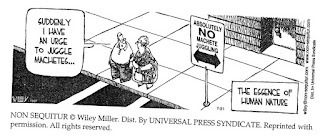
With that 2,000 word ceiling I will be going into this with this question in mind: What is the highlight and what is explanation? I think that this is the best course of action for this assignment.
Now excuse me while I find a machete to hack and slash at my papers.

Random Article I found: Secrets behind London’s mysterious deadly fog revealed
Secrets behind London’s mysterious deadly fog revealed – Can it help save China?: No one gave the fog much thought at first. Fog is a regular occurrence in London, after all. It wasn’t until the late afternoon, when the air took on a yellow color and began to smell like fire....
Monday, November 14, 2016
Proposal Examples, a LS 502 Post
 |
| His desk is cleaner than mine. |
- Sample from Claremont
- AERA example
- GradHacker (why not)
Friday, November 11, 2016
A Step Back, a LS 502 post

I think at this point of my research instead of charging ahead full force (which I've been doing all semester), I am going to take a step back and review everything I have done thus far. I want to make sure that my original intention is still the same since I'm going at it at a broader perspective.
I am going to spend about a day or two looking over what I have before looking at conference proposals. Also, remind myself to take deep calming breaths and not get freaked out by the research.
Subscribe to:
Posts (Atom)